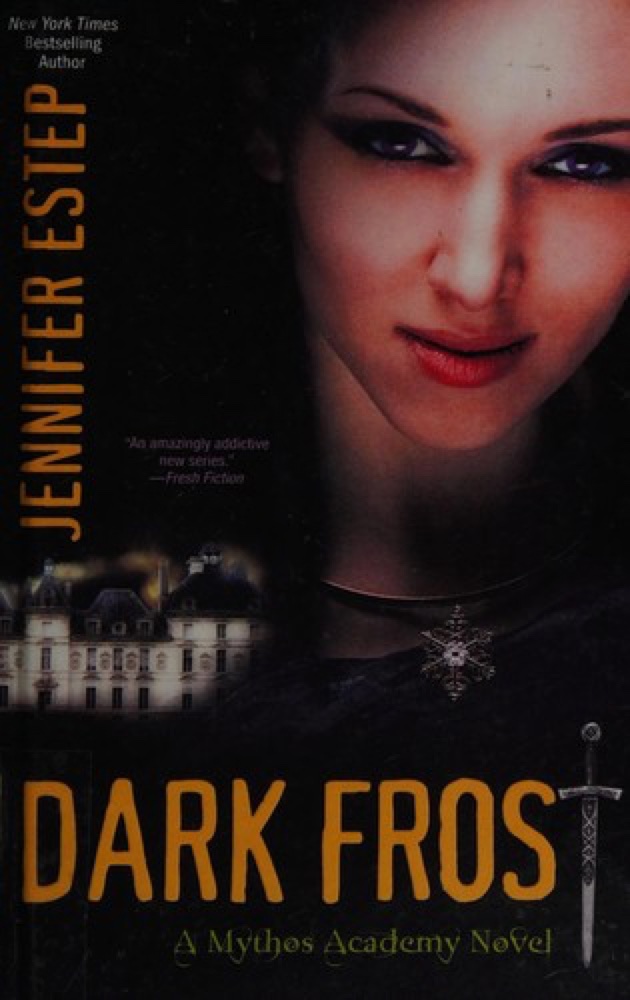


Quotes from Dark Frost

Jennifer Estep ·  336 pages

Rating: (17K votes)


“You won't hurt me. I know you won't." Logan said.
"How can you be so sure?" I whispered.
"Because you're that Gypsy girl, and I'm the bad-boy Spartan. And I think it's time we were finally together, don't you?”
― Jennifer Estep, quote from Dark Frost


“I was so getting tired of fighting for my life in the library.”
― Jennifer Estep, quote from Dark Frost


“They still weren't as cold as my heart was, though.”
― Jennifer Estep, quote from Dark Frost


“All black, of course. Just like his rotting soul.”
― Jennifer Estep, quote from Dark Frost


About the author

Jennifer Estep
See more on GoodReads

Popular quotes

Light is safety; light is life
The first rule of the Arclight.”
― Josin L. McQuein, quote from Arclight


“What we become a part of becomes a part of us.”
― quote from What to Say When You Talk to Yourself


“And red is not the color of apples or roses or the dresses that pretty girls wear in the summertime.

That is not the color of red at all.”
― Rick Yancey, quote from The Isle of Blood


“Non conosceva abbastanza il bondage o qualunque cosa fosse per potersi formare un’opinione personale.
E visto che la conoscenza era l’unica arma in suo possesso per scacciare la paura, Amery aprì il portatile e digitò
“shibari” nel motore di ricerca.
La prima cosa che cercò fu la definizione.
"Shibari-kinbaku è una tecnica che prevede l’utilizzo di corde per dare
vita a un bondage sensuale, spettacolare ed erotico; questa tecnica ha origine nelle arti marziali giapponesi del XVI secolo, nelle punizioni giudiziarie del Giappone del XVIII secolo e nelle produzioni teatrali giapponesi del XIX secolo"
Approfondì la lettura e apprese che quelle pratiche erano inizialmente basate sulle punizioni del bondage jujitsu chiamato hojojutsu. Non c’era da sorprendersi se Ronin si era interessato a quella tecnica, visto che nasceva da
quell’arte marziale che aveva praticato per tutta la vita.
Sembrava che l’hojojutsu fosse diffuso sin dai tempi dei samurai. Quando essi trasportavano i prigionieri, usavano
delle corde per legarli e controllarli dopo la cattura. Alcuni samurai divennero famosi per la loro abilità nell’intrecciare le corde, attività che doveva essere funzionale, ma anche
umana. I samurai entrarono in competizione tra loro: più elaborate e diverse erano le loro opere, maggiore rispetto acquisiva il maestro della corda. Amery apprese anche che i termini si riferivano a due tipi leggermente diversi della stessa disciplina bondage. Lo shibari era più artistico e si concentrava sulla bellezza del disegno delle corde sulla tela umana, era costituito da motivi elaborati e spesso
veniva messo in scena come performance artistica.
Il kinbaku, sebbene avesse in comune molti nodi e legature con lo Shibari, aveva una carica sessuale più marcata.
Istituiva un legame tra il maestro della corda e la persona che veniva legata, fondato sul contatto della pelle durante il processo di legatura, e spesso i nodi venivano posti in zone erogene strategiche.
The Mastered Series - Legami”
― Lorelei James, quote from Bound


“I do not believe in a hereafter; the child was my future life. That was my conception of immortality, and perhaps the only one that has any analogy in reality. If you take that away from me, you cut off my life. LAURA.”
― August Strindberg, quote from The Father


Interesting books

Pop. 1280 (Crime Masterworks)
(6.5K)
Pop. 1280 (Crime Mas...
by Jim Thompson
The Fractal Prince
(6.2K)
The Fractal Prince
by Hannu Rajaniemi
Believe (Rules, #1)
(97)
Believe (Rules, #1)
by Lisa Alfonso
Simple Justice: The History of Brown v. Board of Education and Black America's Struggle for Equality
(526)
Simple Justice: The...
by Richard Kluger
Eternal on the Water
(1.7K)
Eternal on the Water
by Joseph Monninger
Killing Kennedy: The End of Camelot
(42.4K)
Killing Kennedy: The...
by Bill O'Reilly

About BookQuoters

BookQuoters is a community of passionate readers who enjoy sharing the most meaningful, memorable and interesting quotes from great books. As the world communicates more and more via texts, memes and sound bytes, short but profound quotes from books have become more relevant and important. For some of us a quote becomes a mantra, a goal or a philosophy by which we live. For all of us, quotes are a great way to remember a book and to carry with us the author’s best ideas.

We thoughtfully gather quotes from our favorite books, both classic and current, and choose the ones that are most thought-provoking. Each quote represents a book that is interesting, well written and has potential to enhance the reader’s life. We also accept submissions from our visitors and will select the quotes we feel are most appealing to the BookQuoters community.

Founded in 2023, BookQuoters has quickly become a large and vibrant community of people who share an affinity for books. Books are seen by some as a throwback to a previous world; conversely, gleaning the main ideas of a book via a quote or a quick summary is typical of the Information Age but is a habit disdained by some diehard readers. We feel that we have the best of both worlds at BookQuoters; we read books cover-to-cover but offer you some of the highlights. We hope you’ll join us.