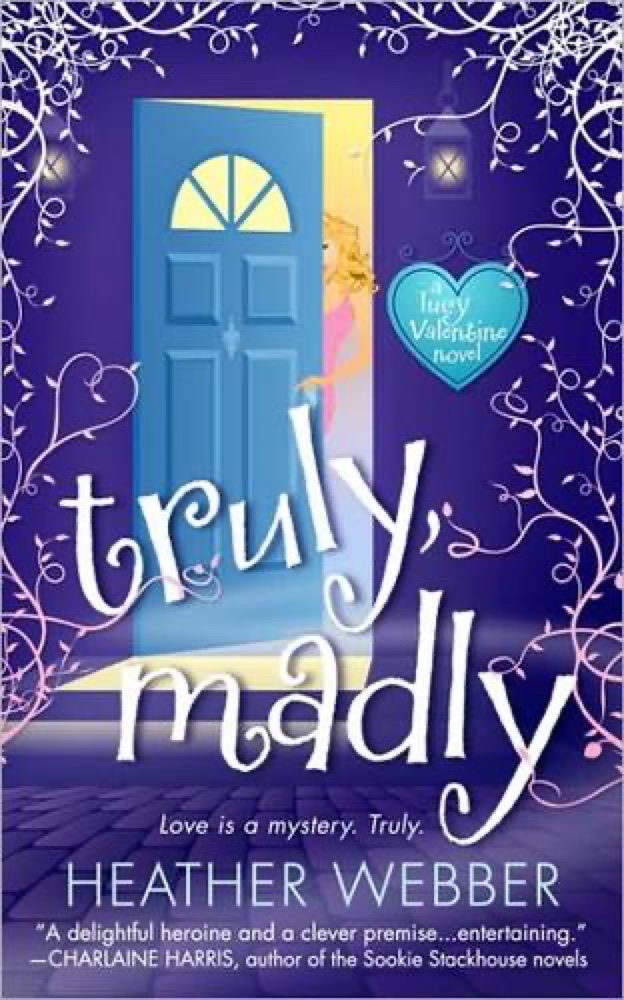

“Tak ada yang lebih buruk daripada iri pada sahabat, atau mengharapka sesuatu yang menurut perasaanmu seharusnya menjadi milikmu.”
― Heather Webber, quote from Truly, Madly
“Aku juga menyukainya. Terlalu menyukainya sehingga tidak bisa kukatakan.”
― Heather Webber, quote from Truly, Madly
“Aku berharap dia ada disini, titik.”
― Heather Webber, quote from Truly, Madly
“Akan datang waktu dalam kehidupan setiap gadis saat dia menyadari bahwa ayahnya tidak sempurna.”
― Heather Webber, quote from Truly, Madly
“Akan datang waktu dalam kehidupan setisp gadis saat dia menyadari bahwa ayahnya tidak sempurna.”
― Heather Webber, quote from Truly, Madly
“The punctuations of silence weren’t completely uncomfortable. Ethan was beginning to understand that in Wayward Pines these periods of shared quiet were normal, expected, inevitable. Some people, by nature, were better at surface conversation than others. Better at walking the line, steering clear of forbidden topics. There was much more thinking before speaking. Like living in a novel of manners.”
― Blake Crouch, quote from Wayward
“The key point is that these patterns, while mostly stable, are not permanent: certain environmental experiences can add or subtract methyls and acetyls, changing those patterns. In effect this etches a memory of what the organism was doing or experiencing into its cells—a crucial first step for any Lamarck-like inheritance. Unfortunately, bad experiences can be etched into cells as easily as good experiences. Intense emotional pain can sometimes flood the mammal brain with neurochemicals that tack methyl groups where they shouldn’t be. Mice that are (however contradictory this sounds) bullied by other mice when they’re pups often have these funny methyl patterns in their brains. As do baby mice (both foster and biological) raised by neglectful mothers, mothers who refuse to lick and cuddle and nurse. These neglected mice fall apart in stressful situations as adults, and their meltdowns can’t be the result of poor genes, since biological and foster children end up equally histrionic. Instead the aberrant methyl patterns were imprinted early on, and as neurons kept dividing and the brain kept growing, these patterns perpetuated themselves. The events of September 11, 2001, might have scarred the brains of unborn humans in similar ways. Some pregnant women in Manhattan developed post-traumatic stress disorder, which can epigenetically activate and deactivate at least a dozen genes, including brain genes. These women, especially the ones affected during the third trimester, ended up having children who felt more anxiety and acute distress than other children when confronted with strange stimuli. Notice that these DNA changes aren’t genetic, because the A-C-G-T string remains the same throughout. But epigenetic changes are de facto mutations; genes might as well not function. And just like mutations, epigenetic changes live on in cells and their descendants. Indeed, each of us accumulates more and more unique epigenetic changes as we age. This explains why the personalities and even physiognomies of identical twins, despite identical DNA, grow more distinct each year. It also means that that detective-story trope of one twin committing a murder and both getting away with it—because DNA tests can’t tell them apart—might not hold up forever. Their epigenomes could condemn them. Of course, all this evidence proves only that body cells can record environmental cues and pass them on to other body cells, a limited form of inheritance. Normally when sperm and egg unite, embryos erase this epigenetic information—allowing you to become you, unencumbered by what your parents did. But other evidence suggests that some epigenetic changes, through mistakes or subterfuge, sometimes get smuggled along to new generations of pups, cubs, chicks, or children—close enough to bona fide Lamarckism to make Cuvier and Darwin grind their molars.”
― Sam Kean, quote from The Violinist's Thumb: And Other Lost Tales of Love, War, and Genius, as Written by Our Genetic Code
“Only time(whatever that may be) will tell.”
― Stephen Hawking, quote from A Brief History of Time: From the Big Bang to Black Holes
“Escape from Mr. Lemoncello’s Library The Island of Dr. Libris Welcome to Wonderland: Home Sweet Motel Welcome to Wonderland: Beach Party Surf Monkey The Haunted Mystery series COAUTHORED WITH JAMES PATTERSON Daniel X: Armageddon Daniel X: Lights Out House of Robots House of Robots: Robots Go Wild! I Funny I Even Funnier I Totally Funniest I Funny TV Jacky Ha-Ha Treasure Hunters Treasure Hunters: Danger Down the Nile Treasure Hunters: Secret of the Forbidden City Treasure Hunters: Peril at the Top of the World Word of Mouse”
― Chris Grabenstein, quote from Mr. Lemoncello's Library Olympics
“Ubijeđen sam da su, u tim zanosima prvih susreta, Dan i žena pogrešno tumačili ono što u vidjeli jedno u drugom. Svako od njih je vidjeo odraz sopstvenog preklinjanja, ranjen pogled i pogrešno ga protumačio kao želju i ispunjenost. Oboje su bill ptići sa slomljenim krilima, koji su tražili da lete privijeni uz drugu pticu sa slomljenim krilima. Ljudi koje se osjećaju isprazno nikada se ne izliječe stapanjem sa drugom nepotpunom osobom. Naprotiv, dvije ptice sa slomljenim krilima spojene u jednu će letjeti nespretno. Nikakva količina strpljenja im neće pomoći da lete; i, konačno, svaki mora biti poduprt različitim stvarima, a rane se stavljaju u odvojene udlage.”
― Irvin D. Yalom, quote from Love's Executioner: & Other Tales of Psychotherapy
BookQuoters is a community of passionate readers who enjoy sharing the most meaningful, memorable and interesting quotes from great books. As the world communicates more and more via texts, memes and sound bytes, short but profound quotes from books have become more relevant and important. For some of us a quote becomes a mantra, a goal or a philosophy by which we live. For all of us, quotes are a great way to remember a book and to carry with us the author’s best ideas.
We thoughtfully gather quotes from our favorite books, both classic and current, and choose the ones that are most thought-provoking. Each quote represents a book that is interesting, well written and has potential to enhance the reader’s life. We also accept submissions from our visitors and will select the quotes we feel are most appealing to the BookQuoters community.
Founded in 2023, BookQuoters has quickly become a large and vibrant community of people who share an affinity for books. Books are seen by some as a throwback to a previous world; conversely, gleaning the main ideas of a book via a quote or a quick summary is typical of the Information Age but is a habit disdained by some diehard readers. We feel that we have the best of both worlds at BookQuoters; we read books cover-to-cover but offer you some of the highlights. We hope you’ll join us.