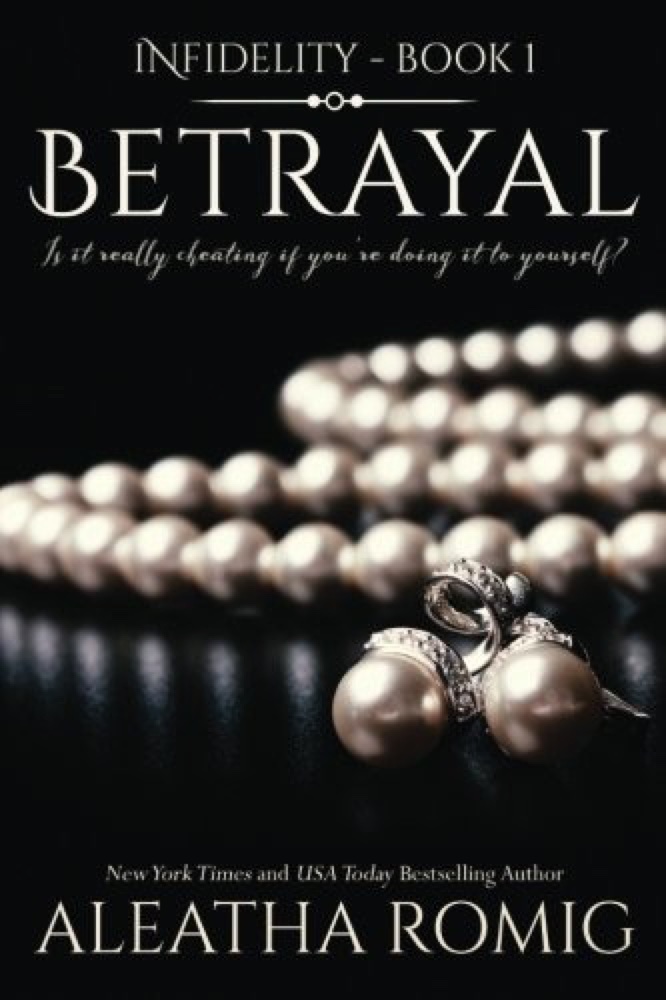

“This man dominated every situation. He was a man who knew what he wanted and took it.”
― Aleatha Romig, quote from Betrayal
“Our first time,” he said, “because there will be more than one time, won’t be what you deserve.”
― Aleatha Romig, quote from Betrayal
“Our first time will be what you want, what you fantasize about. I’m going to take you, right here, right now.”
― Aleatha Romig, quote from Betrayal
“I was once again, Miss Alexandria Charles Montague Collins, the flawless proper lady, pretentious to the help, and people pleaser—the well-bred Southern belle who wore the mask of perfection because no one wanted to see the truth underneath.”
― Aleatha Romig, quote from Betrayal
“DREAMS, LIKE FAIRYTALES, all come to an end. We wake or turn that final page. There’s no escaping it. It may take days, years, or an entire lifetime, but forever doesn’t truly exist.”
― Aleatha Romig, quote from Betrayal
“I looked into the pale blueness of his eyes.”
― Aleatha Romig, quote from Betrayal
“hope was nothing but a vindictive bastard that took up residence inside and gave a false promise of something outside of your control.”
― Aleatha Romig, quote from Betrayal
“Here I am, where I ought to be.”
― Isak Dinesen, quote from Out of Africa
“People fall so in love with their pain, they can’t leave it behind. The same as the stories they tell. We trap ourselves.”
― Chuck Palahniuk, quote from Haunted
“Well, good Christ, how was I supposed to know all that, Hannah? Who looks into the fine points when he's hungry? I'm eight years old and chocolate pudding happens to get me hot. All I have to do is see that deep chocolatey surface gleaming out at me from the refrigerator, and my life isn't my own.”
― Philip Roth, quote from Portnoy's Complaint
“Entirely my own opinion,” said Ivanov. “I am glad that we have reached the heart of the matter soon. In other words: you are convinced that “we” – that is to say, the Party, the State and the masses behind it – no longer represent the interests of the Revolution.”
“I should leave the masses out of it,” said Rubashov. […] “Leave the masses out of it, “ he repeated. “You understand nothing about them. Nor, probably, do I any more. Once, when the great “we” still existed, we understood them as no one had ever understood them before. We had penetrated into their depths, we worked in the amorphous raw material of history itself…” […] “At that time,” Rubashov went on, “we were called the Party of the Plebs. What did the others know of history? Passing ripples, little eddies and breaking waves. They wondered at the changing forms of the surface and could not explain them. But we had descended into the depths, into the formless, anonymous masses, which at all times constituted the substance of history; and we were the first to discover her laws of motion. We had discovered the laws of her inertia, of the slow changing of her molecular structure, and of her sudden eruptions. That was the greatness of our doctrine. The Jacobins were moralists; we were empirics. We dug in the primeval mud of history and there we found her laws. We knew more than ever men have known about mankind; that is why our revolution succeeded. And now you have buried it all again….” […] “Well,” said Rubashov, “one more makes no difference. Everything is buried: the men, their wisdom and their hopes. You killed the “We”; you destroyed it. Do you really maintain that the masses are still behind you? Other usurpers in Europe pretend the same thing with as much right as you….” […] “Forgive my pompousness,” he went on, “but do you really believe the people are still behind you? It bears you, dumb and resigned, as it bears others in other countries, but there is no response in their depths. The masses have become deaf and dumb again, the great silent x of history, indifferent as the sea carrying the ships. Every passing light is reflected on its surface, but underneath is darkness and silence. A long time ago we stirred up the depths, but that is over. In other words” – he paused and put on his pince-nez – “in those days we made history; now you make politics. That’s the whole difference.” […] "A mathematician once said that algebra was the science for lazy people - one does not work out x, but operates with it as if one knew it. In our case, x stands for the anonymous masses, the people. Politics mean operating with this x without worrying about its actual nature. Making history is to recognize x for what it stands for in the equation."
"Pretty," said Ivanov. "But unfortunately rather abstract. To return to more tangible things: you mean, therefore, that "We" - namely, Party and State - no longer represent the interests of the Revolution, of the masses or, if you like, the progress of humanity."
"This time you have grasped it," said Rubashov smiling. Ivanov did not answer his smile.”
― Arthur Koestler, quote from Darkness at Noon
“لعلّهم اعتادوا . ما أسوأ هذا !
لإن الإنسان وهو ميّت يشعر بإن الحياة التي تركها خلفه تسير كما تركها , وكما كانت في الماضي.”
― Orhan Pamuk, quote from My Name is Red
BookQuoters is a community of passionate readers who enjoy sharing the most meaningful, memorable and interesting quotes from great books. As the world communicates more and more via texts, memes and sound bytes, short but profound quotes from books have become more relevant and important. For some of us a quote becomes a mantra, a goal or a philosophy by which we live. For all of us, quotes are a great way to remember a book and to carry with us the author’s best ideas.
We thoughtfully gather quotes from our favorite books, both classic and current, and choose the ones that are most thought-provoking. Each quote represents a book that is interesting, well written and has potential to enhance the reader’s life. We also accept submissions from our visitors and will select the quotes we feel are most appealing to the BookQuoters community.
Founded in 2023, BookQuoters has quickly become a large and vibrant community of people who share an affinity for books. Books are seen by some as a throwback to a previous world; conversely, gleaning the main ideas of a book via a quote or a quick summary is typical of the Information Age but is a habit disdained by some diehard readers. We feel that we have the best of both worlds at BookQuoters; we read books cover-to-cover but offer you some of the highlights. We hope you’ll join us.