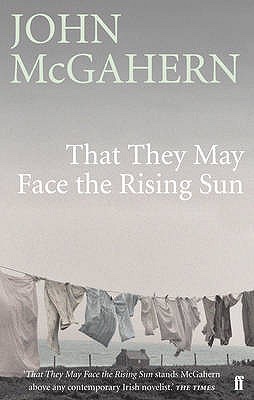
“For the girls the regular comings and goings restored their superior sense of self, a superiority they had received intact from Moran and which was little acknowledged by the wide world in which they had to work and live. That unexplained notion of superiority was often badly shaken and in need of restoration by the time they came home.”
― John McGahern, quote from Amongst Women
“As looking down from great heights brings the urge to fall and end the terror of falling, so his very watching put pressure on them to make a slip as they dried and stacked the plates and cups.”
― John McGahern, quote from Amongst Women
“To leave the everpresent tension of Great Meadow was like shedding stiff, formal clothes or kicking off pinching shoes.”
― John McGahern, quote from Amongst Women
“Той продължи да седи сам, докато цялата му тревога се разтопи в разкоша на самовглъбението.”
― John McGahern, quote from Amongst Women
“Но отдалечавайки се бавно от гробището, групичката здраво сплотени опечалени жени сякаш започна бавно да набира сила с всяка стъпка. Сякаш първата им любов и вярност бяха отдадени безкомпромисно само и единствено на тази къща и този човек и те знаеха, че той винаги е бил живецът във всички етапи от съществуването им. Не само че никога не бяха нарушили верността си към него, но сега подновяваха клетвата си към него заедно с жената, която беше дошла сред тях и се беше омъжила за него. Непрекъснатото им връщане у дома беше потвърждение на несломимото присъствие на къщата в живота им и сега, след като го оставиха под тисовото дърво, сякаш всяка от тях по собствен начин се беше превъплътила в татко.”
― John McGahern, quote from Amongst Women
“Time should have stopped with the clocks but instead it moved in a glazed dream of tiredness without their ticking insistence.”
― John McGahern, quote from Amongst Women
“The light was cut to lace by the trees that had grown so thick with leaves in the last few months.”
― Ann Patchett, quote from Bel Canto
“I mention all this to make the point that if you were designing an organism to look after life in our lonely cosmos, to monitor where it is going and keep a record of where it has been, you wouldn't choose human beings for the job.
But here's an extremely salient point: we have been chosen, by fate or Providence or whatever you wish to call it. It's an unnerving thought that we may be living the universe's supreme achievement and its worst nightmare simultaneously.
Because we are so remarkably careless about looking after things, both when alive and when not, we have no idea-- really none at all-- about how many things have died off permanently, or may soon, or may never, and what role we have played in any part of the process. In 1979, in the book The Sinking Ark, the author Norman Myers suggested that human activities were causing about two extinctions a week on the planet. By the early 1990s he had raised the figure to about some six hundred per week. (That's extinctions of all types-- plants, insects, and so on as well as animals.) Others have put the figure ever higher-- to well over a thousand a week. A United Nations report of 1995, on the other hand, put the total number of known extinctions in the last four hundred years at slightly under 500 for animals and slightly over 650 for plants-- while allowing that this was "almost certainly an underestimate," particularly with regard to tropical species. A few interpreters think most extinction figures are grossly inflated.
The fact is, we don't know. Don't have any idea. We don't know when we started doing many of the things we've done. We don't know what we are doing right now or how our present actions will affect the future. What we do know is that there is only one planet to do it on, and only one species of being capable of making a considered difference. Edward O. Wilson expressed it with unimprovable brevity in The Diversity of Life: "One planet, one experiment."
If this book has a lesson, it is that we are awfully lucky to be here-- and by "we" i mean every living thing. To attain any kind of life in this universe of ours appears to be quite an achievement. As humans we are doubly lucky, of course: We enjoy not only the privilege of existence but also the singular ability to appreciate it and even, in a multitude of ways, to make it better. It is a talent we have only barely begun to grasp.
We have arrived at this position of eminence in a stunningly short time. Behaviorally modern human beings-- that is, people who can speak and make art and organize complex activities-- have existed for only about 0.0001 percent of Earth's history. But surviving for even that little while has required a nearly endless string of good fortune.
We really are at the beginning of it all. The trick, of course, is to make sure we never find the end. And that, almost certainly, will require a good deal more than lucky breaks.”
― Bill Bryson, quote from A Short History of Nearly Everything
“He missed being broke, because when he had nothing he owed nothing and most of his classmates were in the same boat. Now that he had an income he worried constantly about mortgages, the overhead, credit cards, and realizing the American dream of becoming affluent. Not wealthy, just affluent.”
― John Grisham, quote from A Time to Kill
“...she knew in her heart that nature has a preference for a particular order: parents die, then children die. But it was a harsh design, offering little relief from pain, for being in accord with it means that the fortunate find themselves orphaned.”
― Charles Frazier, quote from Cold Mountain
“the ladies, young or old. There is no resisting a cockade,”
― Jane Austen, quote from The Complete Novels
BookQuoters is a community of passionate readers who enjoy sharing the most meaningful, memorable and interesting quotes from great books. As the world communicates more and more via texts, memes and sound bytes, short but profound quotes from books have become more relevant and important. For some of us a quote becomes a mantra, a goal or a philosophy by which we live. For all of us, quotes are a great way to remember a book and to carry with us the author’s best ideas.
We thoughtfully gather quotes from our favorite books, both classic and current, and choose the ones that are most thought-provoking. Each quote represents a book that is interesting, well written and has potential to enhance the reader’s life. We also accept submissions from our visitors and will select the quotes we feel are most appealing to the BookQuoters community.
Founded in 2023, BookQuoters has quickly become a large and vibrant community of people who share an affinity for books. Books are seen by some as a throwback to a previous world; conversely, gleaning the main ideas of a book via a quote or a quick summary is typical of the Information Age but is a habit disdained by some diehard readers. We feel that we have the best of both worlds at BookQuoters; we read books cover-to-cover but offer you some of the highlights. We hope you’ll join us.