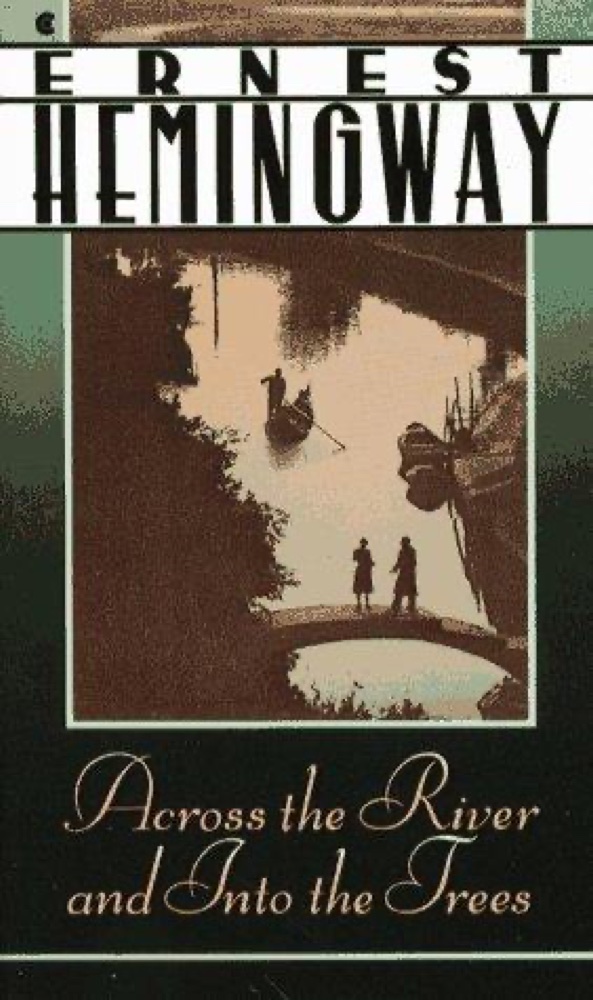

Quotes from Across the River and into the Trees

Ernest Hemingway ·  272 pages

Rating: (6K votes)


“He saw the girl watching him and he smiled at her. It was an old smile that he had been using for fifty years, ever since he first smiled...”
― Ernest Hemingway, quote from Across the River and into the Trees


“I would take anything I love and throw it off the highest cliff you ever saw and not wait to hear it bounce.”
― Ernest Hemingway, quote from Across the River and into the Trees


“When people talk listen completely. Don’t be thinking what you’re going to say. Most people never listen. Nor do they observe. You should be able to go into a room and when you come out know everything that you saw there and not only that. If that room gave you any feeling you should know exactly what it was that gave you that feeling.”
― Ernest Hemingway, quote from Across the River and into the Trees


“He smiled as only the truly shy can smile. It was not the easy grin of the confident, nor the quick slashing smile of the extremely durable and the wicked. It had no relation with the poised, intently used smile of the courtesan or the politician. It was the strange, rare smile which rises from the deep, dark pit, deeper than a well, deep as a mine, that is within them.”
― Ernest Hemingway, quote from Across the River and into the Trees


“It made him feel as a wound does that you think you cannot bear. But you can bear anything, he thought.”
― Ernest Hemingway, quote from Across the River and into the Trees


“In America, they make such things of wire and of sponge-rubber, such as you use in the sets of tanks. You never know there, whether there is any truth in the matter, unless you are a bad boy as I am.”
― Ernest Hemingway, quote from Across the River and into the Trees


“The colonel breakfasted with the leisure of a fighter who has been clipped badly, hears four, and knows how to relax truly for five seconds or more.”
― Ernest Hemingway, quote from Across the River and into the Trees


“When people talk listen completely. Don’t be thinking what you’re going to say. Most people never listen.”
― Ernest Hemingway, quote from Across the River and into the Trees


“Thank you very much,” the girl said. “You know that another woman, or a woman in memory, is a terrible thing for a young girl to deal with when she is still without experience.”
― Ernest Hemingway, quote from Across the River and into the Trees


“Ma che cosa posso raccontare a questa ragazza, ora, in questa fredda mattina ventosa al Gritti Palace Hotel?
“Che cosa vorresti sapere, Figlia?” le chiese
“Tutto quanto.”
“Va bene” disse il colonnello. “Incominciamo.”
― Ernest Hemingway, quote from Across the River and into the Trees


About the author

Ernest Hemingway
Born place: in Oak Park, Illinois, The United States
Born date July 21, 1899
See more on GoodReads

Popular quotes

“Why, the devil, do you see,' said Jack, 'is the seam between the deck-planking and the timbers, and we call it the devil, because it is the /devil/ for the caulkers to come at: in full we say, the devil to pay and no pitch hot; and what we mean is, that there is something hell-fire difficult to be done - must be done - and nothing to do it with. It is a figure.”
― Patrick O'Brian, quote from The Mauritius Command


“I want a man as nice as my retarded dog, but one that doesn't crap on the floor.”
― Laurie Notaro, quote from The Idiot Girls' Action-Adventure Club: True Tales from a Magnificent and Clumsy Life


“She was still thinking of your safety p. 362”
― Jessica Grant, quote from Come, Thou Tortoise


“People in bars are always claiming to be boxers, hoping thereby to ward off attack, like a black snake will vibrate its tail in leaves and try to impersonate a rattlesnake.”
― William S. Burroughs, quote from And the Hippos Were Boiled in Their Tanks


“A film, The Lost Continent, throws a clear light on the current myth of exoticism. It is a big documentary on 'the East', the pretext of which is some undefined ethnographic expedition, evidently false, incidentally, led by three or four Italians into the Malay archipelago. The film is euphoric, everything in it is easy, innocent. Our explorers are good fellows, who fill up their leisure time with child-like amusements: they play with their mascot, a little bear (a mascot is indispensable in all expeditions: no film about the polar region is without its tame seal, no documentary on the tropics is without its monkey), or they comically upset a dish of spaghetti on the deck. Which means that these good people, anthropologists though they are, don't bother much with historical or sociological problems. Penetrating the Orient never means more for them than a little trip in a boat, on an azure sea, in an essentially sunny country. And this same Orient which has today become the political centre of the world we see here all flattened, made smooth and gaudily coloured like an old-fashioned postcard.
The device which produces irresponsibility is clear: colouring the world is always a means of denying it (and perhaps one should at this point begin an inquiry into the use of colour in the cinema). Deprived of all substance, driven back into colour, disembodied through the very glamour of the 'images', the Orient is ready for the spiriting away which the film has in store for it. What with the bear as a mascot and the droll spaghetti, our studio anthropologists will have no trouble in postulating an Orient which is exotic in form, while being in reality profoundly similar to the Occident, at least the Occident of spiritualist thought. Orientals have religions of their own? Never mind, these variations matter very little compared to the basic unity of idealism. Every rite is thus made at once specific and eternal, promoted at one stroke into a piquant spectacle and a quasi-Christian symbol.
...If we are concerned with fisherman, it is not the type of fishing which is whown; but rather, drowned in a garish sunset and eternalized, a romantic essense of the fisherman, presented not as a workman dependent by his technique and his gains on a definite society, but rather as the theme of an eternal condition, in which man is far away and exposed to the perils of the sea, and woman weeping and praying at home. The same applies to refugees, a long procession of which is shown at the beginning, coming down a mountain: to identify them is of course unnecessary: they are eternal essences of refugees, which it is in the nature of the East to produce.”
― Roland Barthes, quote from Mythologies


Interesting books

Silent to the Bone
(5.9K)
Silent to the Bone
by E.L. Konigsburg
The Disappearing Spoon: And Other True Tales of Madness, Love, and the History of the World from the Periodic Table of the Elements
(32K)
The Disappearing Spo...
by Sam Kean
My Inventions
(3.5K)
My Inventions
by Nikola Tesla
The Man Who Loved Children
(3.5K)
The Man Who Loved Ch...
by Christina Stead
The Decay of the Angel
(2.3K)
The Decay of the Ang...
by Yukio Mishima
The Temple of Dawn
(2.5K)
The Temple of Dawn
by Yukio Mishima

About BookQuoters

BookQuoters is a community of passionate readers who enjoy sharing the most meaningful, memorable and interesting quotes from great books. As the world communicates more and more via texts, memes and sound bytes, short but profound quotes from books have become more relevant and important. For some of us a quote becomes a mantra, a goal or a philosophy by which we live. For all of us, quotes are a great way to remember a book and to carry with us the author’s best ideas.

We thoughtfully gather quotes from our favorite books, both classic and current, and choose the ones that are most thought-provoking. Each quote represents a book that is interesting, well written and has potential to enhance the reader’s life. We also accept submissions from our visitors and will select the quotes we feel are most appealing to the BookQuoters community.

Founded in 2023, BookQuoters has quickly become a large and vibrant community of people who share an affinity for books. Books are seen by some as a throwback to a previous world; conversely, gleaning the main ideas of a book via a quote or a quick summary is typical of the Information Age but is a habit disdained by some diehard readers. We feel that we have the best of both worlds at BookQuoters; we read books cover-to-cover but offer you some of the highlights. We hope you’ll join us.