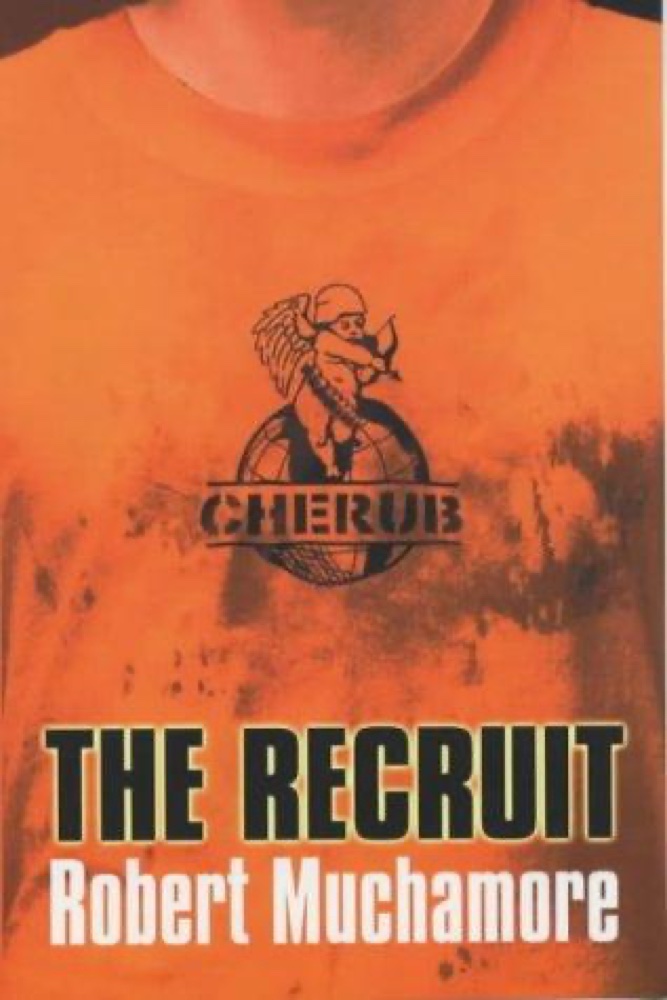

“I'd like to have a business card saying: Bruce Norris kicked your arse.”
― Robert Muchamore, quote from The Recruit
“This is tough but CHERUB's are tougher”
― Robert Muchamore, quote from The Recruit
“A terrorist doesn't let strangers into her flat because they might be undercover police or intelligence agents, but her children bring their mates home and they run all over the place
The terrorist doesn't know that one of these kids has bugged every room in her house, made copies of all her computer files and stolen her address book.
The kid works for CHERUB
CHERUB agents are aged between 10 and 17. They live in the real world, slipping under adult radar and getting information that sends criminals and terrorists to jail.”
― Robert Muchamore, quote from The Recruit
“Nunca puedes predecir lo que pasará en una pelea. Si eres lo bastante estúpido como para iniciar una, serás culpable de lo que ocurra, sea intencionado o no.”
― Robert Muchamore, quote from The Recruit
“No tiene nada de heroico resultar herido por una cuestión de orgullo.”
― Robert Muchamore, quote from The Recruit
“hey its Uberunicorn here, im uploading my accountant for the first time! :D yay! im only uploading the books ive read in a short time: jan-dec, so i might not have so many books online j8st yet... - Uberunicorn, this one called cherub the recruit! Y X 3!!!”
― Robert Muchamore, quote from The Recruit
“Samantha Jennings sat next to him. Teachers thought Samantha was fantastic: always volunteering for stuff, neat uniform, glossed nails. She did all her diagrams with three different colored pens and covered her textbooks in wrapping paper so they looked extra smart. But”
― Robert Muchamore, quote from The Recruit
“James grabbed one of the curtains and used it to wipe the dog crap off his leg.”
― Robert Muchamore, quote from The Recruit
“James realised he’d made friends with a couple of seriously twisted kids.”
― Robert Muchamore, quote from The Recruit
“The rottweiler reared up on its back legs, trying”
― Robert Muchamore, quote from The Recruit
“The Mongols loved competitions of all sorts, and they organized debates among rival religions the same way they organized wrestling matches. It began on a specific date with a panel of judges to oversee it. In this case Mongke Khan ordered them to debate before three judges: a Christian, a Muslim, and a Buddhist. A large audience assembled to watch the affair, which began with great seriousness and formality. An official lay down the strict rules by which Mongke wanted the debate to proceed: on pain of death “no one shall dare to speak words of contention.” Rubruck and the other Christians joined together in one team with the Muslims in an effort to refute the Buddhist doctrines. As these men gathered together in all their robes and regalia in the tents on the dusty plains of Mongolia, they were doing something that no other set of scholars or theologians had ever done in history. It is doubtful that representatives of so many types of Christianity had come to a single meeting, and certainly they had not debated, as equals, with representatives of the various Muslim and Buddhist faiths. The religious scholars had to compete on the basis of their beliefs and ideas, using no weapons or the authority of any ruler or army behind them. They could use only words and logic to test the ability of their ideas to persuade. In the initial round, Rubruck faced a Buddhist from North China who began by asking how the world was made and what happened to the soul after death. Rubruck countered that the Buddhist monk was asking the wrong questions; the first issue should be about God from whom all things flow. The umpires awarded the first points to Rubruck. Their debate ranged back and forth over the topics of evil versus good, God’s nature, what happens to the souls of animals, the existence of reincarnation, and whether God had created evil. As they debated, the clerics formed shifting coalitions among the various religions according to the topic. Between each round of wrestling, Mongol athletes would drink fermented mare’s milk; in keeping with that tradition, after each round of the debate, the learned men paused to drink deeply in preparation for the next match. No side seemed to convince the other of anything. Finally, as the effects of the alcohol became stronger, the Christians gave up trying to persuade anyone with logical arguments, and resorted to singing. The Muslims, who did not sing, responded by loudly reciting the Koran in an effort to drown out the Christians, and the Buddhists retreated into silent meditation. At the end of the debate, unable to convert or kill one another, they concluded the way most Mongol celebrations concluded, with everyone simply too drunk to continue.”
― Jack Weatherford, quote from Genghis Khan and the Making of the Modern World
“At the happy ending of the Tempest, Prospero brings the kind back togeter with his son, and finds Miranda's true love and punishes the bad duke and frees Ariel and becomes a duke himself again. Everyone - except Caliban - is happy, and everyone is forgiven, and everyone is fine, and they all sail away on calm seas. Happy endings.
That's how it is in Shakespeare.
But Shakespeare was wrong.
Sometimes there isn't a Prospero to make everything fine again.
And sometimes the quality of mercy is strained.”
― Gary D. Schmidt, quote from Lizzie Bright and the Buckminster Boy
“Any man who lives by his beliefs is to be admired, not mocked.”
― Julie Garwood, quote from For the Roses
“Because, the moment you chose to start a small business, Sarah, you unwittingly chose to play a significantly larger game than any game you had ever played before.”
― Michael E. Gerber, quote from The E-Myth Revisited: Why Most Small Businesses Don't Work and What to Do About It
“Every reader should ask himself periodically ``Toward what end, toward what end?'' -- but do not ask it too often lest you pass up the fun of programming for the constipation of bittersweet philosophy.”
― Harold Abelson, quote from Structure and Interpretation of Computer Programs (MIT Electrical Engineering and Computer Science)
BookQuoters is a community of passionate readers who enjoy sharing the most meaningful, memorable and interesting quotes from great books. As the world communicates more and more via texts, memes and sound bytes, short but profound quotes from books have become more relevant and important. For some of us a quote becomes a mantra, a goal or a philosophy by which we live. For all of us, quotes are a great way to remember a book and to carry with us the author’s best ideas.
We thoughtfully gather quotes from our favorite books, both classic and current, and choose the ones that are most thought-provoking. Each quote represents a book that is interesting, well written and has potential to enhance the reader’s life. We also accept submissions from our visitors and will select the quotes we feel are most appealing to the BookQuoters community.
Founded in 2023, BookQuoters has quickly become a large and vibrant community of people who share an affinity for books. Books are seen by some as a throwback to a previous world; conversely, gleaning the main ideas of a book via a quote or a quick summary is typical of the Information Age but is a habit disdained by some diehard readers. We feel that we have the best of both worlds at BookQuoters; we read books cover-to-cover but offer you some of the highlights. We hope you’ll join us.