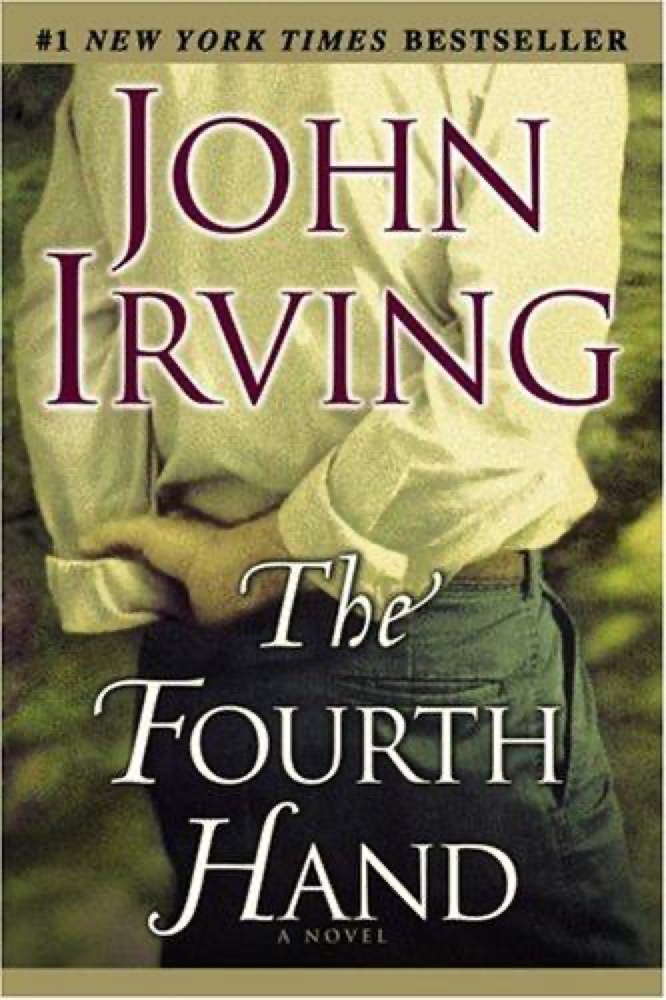

Quotes from The Fourth Hand

John Irving ·  368 pages

Rating: (25.7K votes)


“Lemties neįmanoma įžvelgti, nebent jei sapnuoji ar esi apsvaigęs iš meilės.”
― John Irving, quote from The Fourth Hand


“Aren’t eccentricities fairly common among overachievers.”
― John Irving, quote from The Fourth Hand


“As for Dr. Zajac’s modest contribution to the ongoing pollution of the Charles River… well, let’s be fair… In his hopelessly old-fashioned opinion, a lot worse than dogshit was dumped into the Charles on daily basis.”
― John Irving, quote from The Fourth Hand


“And feeling like a failed sexual predator, because of pregnant Mary…”
― John Irving, quote from The Fourth Hand


“Americans are suckers for an English accent.”
― John Irving, quote from The Fourth Hand


“When they weren’t praying, they did what schoolgirls everywhere do. They laughed, they shrieked, they burst into hysterical sobs – all for no apparent reason…

The schoolgirls also played the worst Western music imaginable, and they took a surfeit of baths – so many baths that the traditional inn where Wallingford and Evelyn Arbuthnot stayed was repeatedly running out of hot water.”
― John Irving, quote from The Fourth Hand


“There is often a defining experience that marks any significant change in the course of a person’s life.”
― John Irving, quote from The Fourth Hand


“Was he nice? He didn’t know. He hoped he was, but how many of us truly know?”
― John Irving, quote from The Fourth Hand


About the author

John Irving
Born place: in Exeter, New Hampshire, The United States
See more on GoodReads

Popular quotes

“The amount that she loved us was beyond her reach. It could not be quantified or contained. It was the ten thousand named things in the Tao Te Ching’s universe and then ten thousand more. Her love was full-throated and all-encompassing and unadorned. Every day she blew through her entire reserve.”
― Cheryl Strayed, quote from Wild: From Lost to Found on the Pacific Crest Trail


“He thought about alone in Constantinople that time, having quarreled in Paris before he had gone out. He had whored the whole time and then, when that was over, and he had failed to kill his loneliness, but only made it worse, he had written her, the first one, the one who left him, a letter telling her how he had never been able to kill it . . . . How when he thought he saw her outside the Regence one time it made him go all faint and sick inside, and that he would follow a woman that looked like her in some way, along the Boulevard, afraid to see it was not she, afraid to lose the feeling it gave him. How every one he had slept with had only made him miss her more. How what she had done could never matter since he could never cure himself of loving her.”
― Ernest Hemingway, quote from The Complete Short Stories


“If you have read this far in the chronicle of the Baudelaire orphans - and I certainly hope you have not - then you know we have reached the thirteenth chapter of the thirteenth volume in this sad history, and so you know the end is near, even though this chapter is so lengthy that you might never reach the end of it. But perhaps you do not yet know what the end really means. "The end" is a phrase which refers to the completion of a story, or the final moment of some accomplishment, such as a secret errand, or a great deal of research, and indeed this thirteenth volume marks the completion of my investigation into the Baudelaire case, which required much research, a great many secret errands, and the accomplishments of a number of my comrades, from a trolley driver to a botanical hybridization expert, with many, many typewriter repairpeople in between. But it cannot be said that The End contains the end of the Baudelaires' story, any more than The Bad Beginning contained its beginning. The children's story began long before that terrible day on Briny Beach, but there would have to be another volume to chronicle when the Baudelaires were born, and when their parents married, and who was playing the violin in the candlelit restaurant when the Baudelaire parents first laid eyes on one another, and what was hidden inside that violin, and the childhood of the man who orphaned the girl who put it there, and even then it could not be said that the Baudelaires' story had not begun, because you would still need to know about a certain tea party held in a penthouse suite, and the baker who made the scones served at the tea party, and the baker's assistant who smuggled the secret ingredient into the scone batter through a very narrow drainpipe, and how a crafty volunteer created the illusion of a fire in the kitchen simply by wearing a certain dress and jumping around, and even then the beginning of the story would be as far away as the shipwreck that leftthe Baudelaire parents as castaways on the coastal shelf is far away from the outrigger on which the islanders would depart. One could say, in fact, that no story really has a beginning, and that no story really has an end, as all of the world's stories are as jumbled as the items in the arboretum, with their details and secrets all heaped together so that the whole story, from beginning to end, depends on how you look at it. We might even say that the world is always in medias res - a Latin phrase which means "in the midst of things" or "in the middle of a narrative" - and that it is impossible to solve any mystery, or find the root of any trouble, and so The End is really the middle of the story, as many people in this history will live long past the close of Chapter Thirteen, or even the beginning of the story, as a new child arrives in the world at the chapter's close. But one cannot sit in the midst of things forever. Eventually one must face that the end is near, and the end of The End is quite near indeed, so if I were you I would not read the end of The End, as it contains the end of a notorious villain but also the end of a brave and noble sibling, and the end of the colonists' stay on the island, as they sail off the end of the coastal shelf. The end of The End contains all these ends, and that does not depend on how you look at it, so it might be best for you to stop looking at The End before the end of The End arrives, and to stop reading The End before you read the end, as the stories that end in The End that began in The Bad Beginning are beginning to end now.”
― Lemony Snicket, quote from The End


“It's all trivial-your grouse, my hermit, Bernard's Byron. Comparing what we're looking for misses the point. It's wanting to know that makes us matter. Otherwise we're going out the way we came in. That's why you can't believe in the afterlife, Valentine. Believe in the after but not the life. Believe in god, the solid, the spirit, the infinite, believe in angels if you like, but not in the great celestial get-together for an exchange of view. If the answers are in the back of the book I can wait, but what a drag. Better to struggle on knowing that failure is final.”
― Tom Stoppard, quote from Arcadia


“A Russian cosmonaut and a Russian brain surgeon were once discussing Christianity. The brain surgeon was a Christian, but the cosmonaut wasn’t. ‘I have been in outer space many times,’ bragged the cosmonaut, ‘but I have never seen any angels.’ The brain surgeon stared in amazement, but then he said, ‘And I have operated on many intelligent brains, but I have never seen a single thought.”
― Jostein Gaarder, quote from The Solitaire Mystery: A Novel About Family and Destiny


Interesting books

Goodbye to Berlin
(6.7K)
Goodbye to Berlin
by Christopher Isherwood
Dying of the Light
(4.2K)
Dying of the Light
by George R.R. Martin
Berenice
(2.2K)
Berenice
by Edgar Allan Poe
Freddy and Fredericka
(3.4K)
Freddy and Frederick...
by Mark Helprin
The Bostonians
(5.6K)
The Bostonians
by Henry James
The Blood of Others
(1.4K)
The Blood of Others
by Simone de Beauvoir

About BookQuoters

BookQuoters is a community of passionate readers who enjoy sharing the most meaningful, memorable and interesting quotes from great books. As the world communicates more and more via texts, memes and sound bytes, short but profound quotes from books have become more relevant and important. For some of us a quote becomes a mantra, a goal or a philosophy by which we live. For all of us, quotes are a great way to remember a book and to carry with us the author’s best ideas.

We thoughtfully gather quotes from our favorite books, both classic and current, and choose the ones that are most thought-provoking. Each quote represents a book that is interesting, well written and has potential to enhance the reader’s life. We also accept submissions from our visitors and will select the quotes we feel are most appealing to the BookQuoters community.

Founded in 2023, BookQuoters has quickly become a large and vibrant community of people who share an affinity for books. Books are seen by some as a throwback to a previous world; conversely, gleaning the main ideas of a book via a quote or a quick summary is typical of the Information Age but is a habit disdained by some diehard readers. We feel that we have the best of both worlds at BookQuoters; we read books cover-to-cover but offer you some of the highlights. We hope you’ll join us.