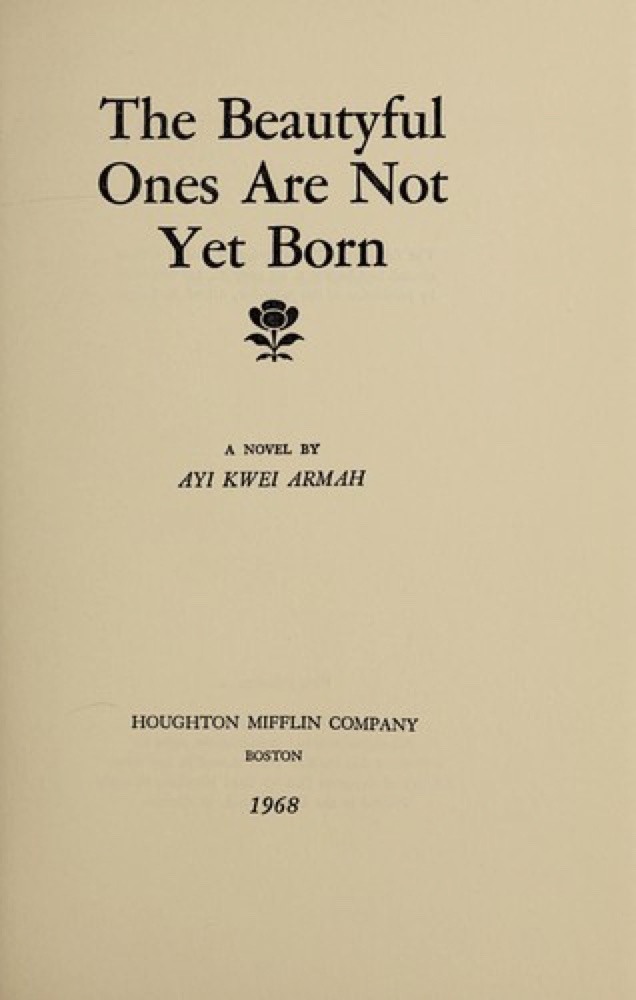

Ayi Kwei Armah · 191 pages
Rating: (2K votes)
“Alone, i am nothing. i have nothing.we have power.but we will never know it,we will never see it work.unless we come together to make it work.”
― Ayi Kwei Armah, quote from The Beautyful Ones Are Not Yet Born
“Disgust with injustice may sharpen the desire for justice. Readers who don’t see this connection merely wish to be entertained, and I have neither skill nor desire to turn the agony of a people into entertainment.”
― Ayi Kwei Armah, quote from The Beautyful Ones Are Not Yet Born
“The sand looked so beautiful then, so many little individual grains in the light of the night, giving the watcher the childhood feeling of infinite things finally understood, the humiliating feeling of the watcher's nothingness.”
― Ayi Kwei Armah, quote from The Beautyful Ones Are Not Yet Born
“True, I used to see a lot of hope. I saw men tear down the veils behind which the truth had been hidden. But then the same men, when they have power in their hands at last, began to find the veils useful. They made many more. Life has not changed. Only some people have been growing, becoming different, that is all. After a youth spent fighting the white man, why should not the president discover as he grows older that his real desire has been to be like the white governor himself, to live above all the blackness in the big old slave castle?”
― Ayi Kwei Armah, quote from The Beautyful Ones Are Not Yet Born
“Outrage alternated with a sweaty fear he had never before felt. Something, it seemed to him was being drained from him, leaving the body feeling like a very dry sponge, very light, completely at the mercy of sly toying gusts of wind.”
― Ayi Kwei Armah, quote from The Beautyful Ones Are Not Yet Born
“Literature may increase one’s depth of knowledge, but not all knowledge be found in literature. Only with practical experience can one truly learn and thus be considered knowledgeable.”
― Lynette Noni, quote from Akarnae
“...disfrutaría de la venganza más verdadera de todas: haría que mi vida tuviera un sentido.”
― S.J. Kincaid, quote from The Diabolic
“Dintre toate lipsurile studentului, cea dintîi şi cea mai de seamă era fără îndoială lipsa de respect faţă de tatăl lui. De altfel şi bătrînul era adesea plicticos de n-avea pereche. In primul rînd era peste măsură de curios, în al doilea rînd nu-l lăsa să înveţe, pentru că trăncănea într-una şi punea întrebări prosteşti — lipsite cu totul de temei şi, în cele din urmă, mai venea uneori şi beat. Fiul îşi dezvăţa încetul cu încetul părintele de aceste păcate, adică de dorinţa de a-şi vîrî nasul pretutindeni şi de a trăncăni verzi şi uscate, şi, în sfîrşit, izbuti să-l facă pe bătrîn să-l asculte ca pe un oracol şi să nu deschidă gura fără îngăduinţa lui. Bietul bătrîn nu mai contenea să se minuneze şi să se bucure de Petenka al lui (aşa-i spunea el). Cînd venea să-l vadă, era întotdeauna sfios şi îngrijorat, neştiind pesemne cum o să-l primească fiul şi nu îndrăznea multă vreme să-i calce pragul; dacă mă nimerea pe mine prin apropiere, mă descosea pe puţin vreo douăzeci de minute, întrebîndu-mă cum e cu Petenka al lui? Dacă-i sănătos, în ce ape se scaldă şi dacă nu lucrează cumva la ceva cu totul deosebit ? Şi ce anume face : scrie, citeşte sau cugetă ? Dacă-l îmbărbătam şi-l linişteam îndeajuns, bătrînul îşi lua în cele din urmă inima în dinţi şi intra tiptil-tiptil, deschizînd încetinel uşa, prin care vîra mai întîi capul; dacă vedea că băiatul lui nu se supără şi-i face un semn, trecea binişor în odaie, îşi lepăda paltonaşul şi pălăria — veşnic boţită, găurită şi cu marginile rupte — le atîrna în cuier, cu multă băgare de seamă şi fără zgomot; apoi se aşeza într-un colţ, pe scaun, tot atît de încetişor şi-l mînea din ochi pe Petenka al lui, prinzîndu-i toate mişcările şi căutînd să ghicească în ce toane e. Dacă Petenka nu era cît de cît în apele lui şi bătrînul o vedea, se ridica numaidecît şi spunea : «Eu, Petenka, numai aşa... am trecut doar pentru o clipă. Să vezi... am fost departe şi dacă am trecut pe aici, am intrat să mă odihnesc». Apoi îşi lua tăcut şi supus paltonaşul şi pălăria ponosită, deschidea iar uşa fără zgomot şi pleca, cu un zîmbet silit, ca să înăbuşe durerea strînsă în suflet şi să nu i-o arate fiului. Dar cînd se-ntîmpla ca fiul să-şi primească bine tatăl, acesta nu mai ştia ce să facă de bucurie. Mulţumirea i se citea pe faţă, în purtări, în mişcări. De cîte ori îi vorbea băiatul, bătrînul se sălta puţin de pe scaun şi-i răspundea încet, slugarnic, aproape cu evlavie, căutînd să întrebuinţeze vorbele cele mai alese, adică cele mai caraghioase. Dar, hotărît lucru, vorbirea frumoasă nu prea era de el: se încurca şi se fîstîcea în aşa hal, că nu ştia ce să mai facă cu mîinile şi ce să se facă el singur, şi multă vreme după ce isprăvea, mai bolborosea pentru el răspunsul cuvenit, căutînd parcă să-şi îndrepte greşeala. Dacă izbutea să răspundă cum trebuie, bătrînul se umfla în pene, îşi îndrepta pe rînd jiletca, cravata şi haina şi lua înfăţişarea unui om care-şi cunoaşte preţul. Uneori prindea atîta curaj, îndrăzneala lui mergea atît de departe, că se ridica încet de pe scaun, se apropia de raftul cu cărţi, îşi alegea o carte şi citea pe loc cîte ceva, aşa, la nimereală. Toate astea le făcea cu un sînge rece şi o nepăsare prefăcută, de parcă ar fi avut libertatea să umble întotdeauna în voie prin cărţile fiului său, de parcă ar fi fost obişnuit de cînd lumea cu vorba mîngîietoare a acestuia. Eu însă am văzut odată cu ochii mei cum s-a speriat bietul de el, cînd Pokrovski l-a rugat să nu mai pună mîna pe cărţi. Bătrînul s-a fîstîcit, s-a grăbit, a pus cartea de-a-ndoaselea, apoi a dat să-şi îndrepte greşeala, a întors-o, dar a băgat-o cu cotorul înăuntru; şi toate astea le făcea zîmbind, înroşindu-se şi căutînd să şteargă, cum se pricepea mai bine, urmele fărădelegii.”
― Fyodor Dostoyevsky, quote from Poor Folk
“There was no explaining this thing, but it was so. he was on Xapur, and that fantastic heap of towering masonry was on Xapur, and all was madness and paradox; yet it was all true.”
― Robert E. Howard, quote from Conan of Cimmeria
“I have these secret pangs of shame about being single, like I wasn't good enough to get a husband. Rita reminded me of something I'd told her once, about the five rules of the world as arrived at by this Catholic priest named Tom Weston. The first rule, he says, is that you must not have anything wrong with you or anything different. The second one is that if you do have something wrong with you, you must get over it as soon as possible. The third rule is that if you can't get over it, you must pretend that you have. The fourth rule is that if you can't even pretend that you have, you shouldn't show up. You should stay home, because it's hard for everyone else to have you around. And the fifth rule is that if you are going to insist on showing up, you should at least have the decency to feel ashamed.
So Rita and I decided that the most subversive, revolutionary thing I could do was to show up for my life and not be ashamed.”
― Anne Lamott, quote from Operating Instructions: A Journal of My Son's First Year
BookQuoters is a community of passionate readers who enjoy sharing the most meaningful, memorable and interesting quotes from great books. As the world communicates more and more via texts, memes and sound bytes, short but profound quotes from books have become more relevant and important. For some of us a quote becomes a mantra, a goal or a philosophy by which we live. For all of us, quotes are a great way to remember a book and to carry with us the author’s best ideas.
We thoughtfully gather quotes from our favorite books, both classic and current, and choose the ones that are most thought-provoking. Each quote represents a book that is interesting, well written and has potential to enhance the reader’s life. We also accept submissions from our visitors and will select the quotes we feel are most appealing to the BookQuoters community.
Founded in 2023, BookQuoters has quickly become a large and vibrant community of people who share an affinity for books. Books are seen by some as a throwback to a previous world; conversely, gleaning the main ideas of a book via a quote or a quick summary is typical of the Information Age but is a habit disdained by some diehard readers. We feel that we have the best of both worlds at BookQuoters; we read books cover-to-cover but offer you some of the highlights. We hope you’ll join us.