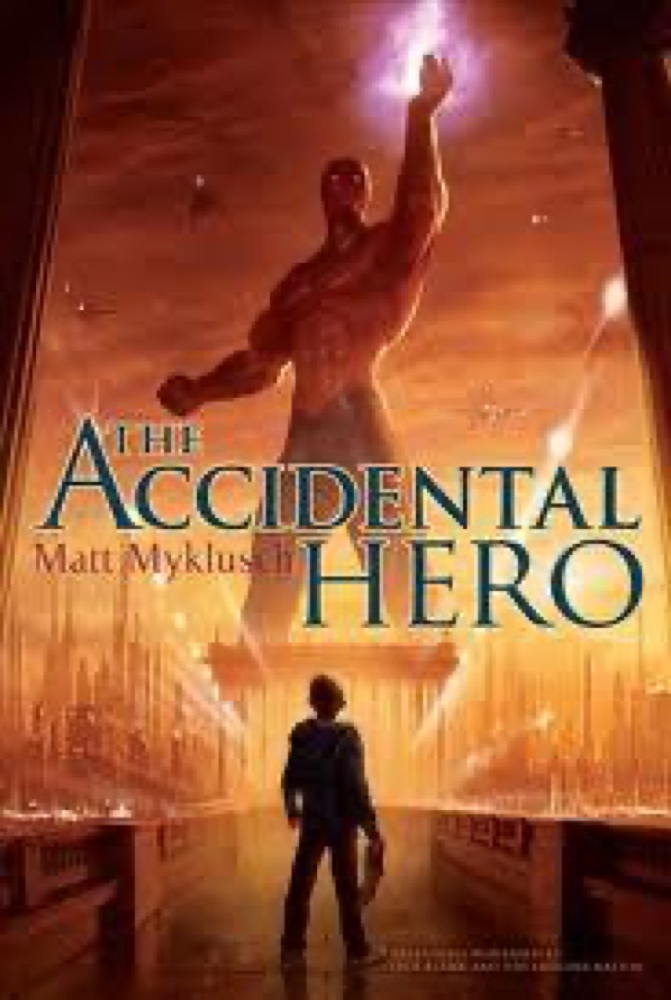

“...the future is not written. It lies in the choices you make. Our future is ours to decide. Always.”
― Matt Myklusch, quote from The Accidental Hero
“The 'bad guys' are the ones who are often misunderstood”
― Matt Myklusch, quote from The Accidental Hero
“Imagination is ever changing and never static.”
― Matt Myklusch, quote from The Accidental Hero
“I'm just a kid who would really love to no be dissected.”
― Matt Myklusch, quote from The Accidental Hero
“You have to drive! You think I trust that big blue knucklehead to get us there?”
― Matt Myklusch, quote from The Accidental Hero
“CRUSHING THE SPIRIT OF CHILDHOOD SINCE 1898.”
― Matt Myklusch, quote from The Accidental Hero
“Luther was the unwitting harbinger of a new world in which the well-established boundaries of what was acceptable were exploded, never to be restored. Suddenly the individual had not only the freedom and possibility of thinking for himself but the weighty responsibility before God of doing so.”
― Eric Metaxas, quote from Martin Luther: The Man Who Rediscovered God and Changed the World
“They had no idea her Valyusha wasn’t the real threat. Silver would annihilate anyone who dared hurt him again.”
― Nalini Singh, quote from Silver Silence
“I realize today that nothing in the world is more distasteful to a man than to take the path that leads to himself.”
― Hermann Hesse, quote from Demian
“But certainly the two best-known tales in the neighborhood - the key hauntings, if you will - concern the Red Room and the Screaming Staircase.'
There was a profound silence, abruptly broken by an enormously loud rumble from George's stomach. Plaster didn't actually fall from the ceiling, but it was close.
'Sorry,' he said cheerfully. 'Famished. I think I"ll have another doughnut, if you don't mind. Any takers?”
― Jonathan Stroud, quote from Die Seufzende Wendeltreppe
“And are we not guilty of offensive disparagement in calling chess a game? Is it not also a science and an art, hovering between those categories as Muhammad’s coffin hovered between heaven and earth, a unique link between pairs of opposites: ancient yet eternally new; mechanical in structure, yet made effective only by the imagination; limited to a geometrically fixed space, yet with unlimited combinations; constantly developing, yet sterile; thought that leads nowhere; mathematics calculating nothing; art without works of art; architecture without substance – but nonetheless shown to be more durable in its entity and existence than all books and works of art; the only game that belongs to all nations and all eras, although no one knows what god brought it down to earth to vanquish boredom, sharpen the senses and stretch the mind. Where does it begin and where does it end? Every child can learn its basic rules, every bungler can try his luck at it, yet within that immutable little square it is able to bring forth a particular species of masters who cannot be compared to anyone else, people with a gift solely designed for chess, geniuses in their specific field who unite vision, patience and technique in just the same proportions as do mathematicians, poets, musicians, but in different stratifications and combinations. In the old days of the enthusiasm for physiognomy, a physician like Gall might perhaps have dissected a chess champion’s brain to find out whether some particular twist or turn in the grey matter, a kind of chess muscle or chess bump, is more developed in such chess geniuses than in the skulls of other mortals. And how intrigued such a physiognomist would have been by the case of Czentovic, where that specific genius appeared in a setting of absolute intellectual lethargy, like a single vein of gold in a hundredweight of dull stone. In principle, I had always realized that such a unique, brilliant game must create its own matadors, but how difficult and indeed impossible it is to imagine the life of an intellectually active human being whose world is reduced entirely to the narrow one-way traffic between black and white, who seeks the triumphs of his life in the mere movement to and fro, forward and back of thirty-two chessmen, someone to whom a new opening, moving knight rather than pawn, is a great deed, and his little corner of immortality is tucked away in a book about chess – a human being, an intellectual human being who constantly bends the entire force of his mind on the ridiculous task of forcing a wooden king into the corner of a wooden board, and does it without going mad!”
― Stefan Zweig, quote from Schachnovelle
BookQuoters is a community of passionate readers who enjoy sharing the most meaningful, memorable and interesting quotes from great books. As the world communicates more and more via texts, memes and sound bytes, short but profound quotes from books have become more relevant and important. For some of us a quote becomes a mantra, a goal or a philosophy by which we live. For all of us, quotes are a great way to remember a book and to carry with us the author’s best ideas.
We thoughtfully gather quotes from our favorite books, both classic and current, and choose the ones that are most thought-provoking. Each quote represents a book that is interesting, well written and has potential to enhance the reader’s life. We also accept submissions from our visitors and will select the quotes we feel are most appealing to the BookQuoters community.
Founded in 2023, BookQuoters has quickly become a large and vibrant community of people who share an affinity for books. Books are seen by some as a throwback to a previous world; conversely, gleaning the main ideas of a book via a quote or a quick summary is typical of the Information Age but is a habit disdained by some diehard readers. We feel that we have the best of both worlds at BookQuoters; we read books cover-to-cover but offer you some of the highlights. We hope you’ll join us.