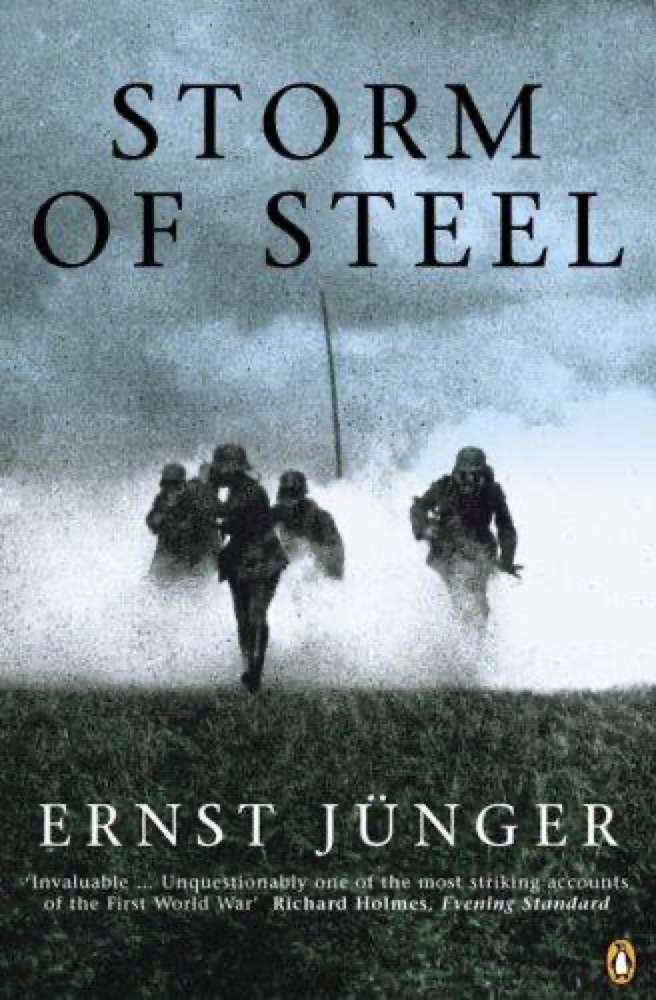
 Eumeswil
Quotes from the Book
Habent sua fata libelli et balli [Books and bullets have their own destinies]
These moments of nocturnal prowling leave an indelible impression. Eyes and ears are tensed to the maximum, the rustling approach of strange feet in the tall grass in an unutterably menacing thing. Your breath comes in shallow bursts; you have to force yourself to stifle any panting or wheezing. There is a little mechanical click as the safety-catch of your pistol is taken off; the sound cuts straight through your nerves. Your teeth are grinding on the fuse-pin of the hand-grenade. The encounter will be short and murderous. You tremble with two contradictory impulses: the heightened awareness of the huntsmen, and the terror of the quarry. You are a world to yourself, saturated with the appalling aura of the savage landscape. p. 71
Throughout the war, it was always my endeavour to view my opponent without animus, and to form an opinion of him as a man on the basis of the courage he showed. I would always try and seek him out in combat and kill him, and I expected nothing else from him. But never did I entertain mean thoughts of him. When prisoners fell into my hands, later on, I felt responsible for their safety, and would always do everything in my power for them. p. 58
At the sight of the Neckar slopes wreathed with flowering cherry trees, I had a strong sense of having come home. What a beautiful country it was, and eminently worth our blood and our lives. Never before had I felt its charm so clearly. I had good and serious thoughts, and for the first time I sensed that this war was more than just a great adventure. p. 33
We had come from lecture halls, school desks and factory workbenches, and over the brief weeks of training, we had bonded together into one large and enthusiastic group. Grown up in an age of security, we shared a yearning for danger, for the experience of the extraordinary. We were enraptured by war.
When once it is no longer possible to understand how a man gives his life for his country--and the time will come--then all is over with that faith also, and the idea of the Fatherland is dead; and then, perhaps, we shall be envied, as we envy the saints their inward and irresistible strength.
Trench fighting is the bloodiest, wildest, most brutal of all ... Of all the war's exciting moments none is so powerful as the meeting of two storm troop leaders between narrow trench walls. There's no mercy there, no going back, the blood speaks from a shrill cry of recognition that tears itself from one's breast like a nightmare.
This was the home of the great god Pain, and for the first time I looked through a devilish chink into the depths of his realm. And fresh shells came down all the time.
In a curious failure of comprehension, I looked alertly about me for possible targets for all this artillery fire, not, apparently, realizing that it was actually ourselves that the enemy gunners were trying for all they were worth to hit.
IT is not impossible that among the English readers of this book there may be one who in 1915 and 1916 was in one of those trenches that were woven like a web among the ruins of Monchy-au-Bois. In that case he had opposite him at that time the 73rd Hanoverian Fusiliers, who wear as their distinctive badge a brassard with ' Gibraltar ' inscribed on it in gold, in memory of the defence of that fortress under General Elliot; for this, besides Waterloo, has its place in the regiment's history. At the time I refer to I was a nineteen-year-old lieutenant in command of a platoon, and my part of the line was easily recognizable from the English side by a row of tall shell-stripped trees that rose from the ruins of Monchy. My left flank was bounded by the sunken road leading to Berles-au-Bois, which was in the hands of the English ; my right was marked by a sap running out from our lines, one that helped us many a time to make our presence felt by means of bombs and rifle-grenades. I daresay this reader remembers, too, the white tom-cat, lamed in one foot by a stray bullet, who had his headquarters in No-man's-land. He used often to pay me a visit at night in my dugout. This creature, the sole living being that was on visiting terms with both sides, always made on me an impression of extreme mystery. This charm of mystery which lay over all that belonged to the other side, to that danger zone full of unseen figures, is one of the strongest impressions that the war has left with me. At that time, before the battle of the Somme, which opened a new chapter in the history of the war, the struggle had not taken on that grim and mathematical aspect which cast over its landscapes a deeper and deeper gloom. There was more rest for the soldier than in the later years when he was thrown into one murderous battle after another ; and so it is that many of those days come back to my memory now with a light on them that is almost peaceful.
Die Männer hatten die Bajonette aufgepflanzt. Sie standen in steinerner Unbeweglichkeit, das Gewehr in der Hand, am vorderen Hange des Hohlwegs und starrten in das Vorgelände. Ab und zu, beim Schein einer Leuchtkugel, sah ich Stahlhelm an Stahlhelm, Klinge an Klinge blinken und wurde von einem Gefühl der Unverletzbarkeit erfüllt. Wir konnten zermalmt, aber nicht besiegt werden.
In the space of a single year, a crumbling rural village had sprouted an army town, like a great parasitical growth. The former peacetime aspect of the place was barely discernible. The village pond was where the dragoons watered their horses, infantry exercised in the orchards, soldiers lay in the meadows sunning themselves. All the peacetime institutions collapsed, only what was needed for war remained. Hedges and fences were broken or simply torn down for easier access, and everywhere there were large signs giving directions to military traffic. While roofs caved in, and furniture was gradually used up as firewood, telephone lines and electricity cables were installed. Cellars were extended outwards and downwards to make bomb shelters for the residents; the removed earth was dumped in the gardens. The village no longer knew any demarcations or distinctions between thine and mine. pp. 36-37
Now these [battles] too are over, and already we see once more in the dim light of the future the tumult of the fresh ones. We--by this I mean those youth of this land who are capable of enthusiasm for an ideal--will not shrink from them. We stand in the memory of the dead who are holy to us, and we believe ourselves entrusted with the true and spiritual welfare of our people. We stand for what will be and for what has been. Though force without and barbarity within conglomerate in sombre clouds, yet so long as the blade of a sword will strike a spark in the night may it be said: Germany lives and Germany shall never go under!
Irgendwie drängt sich auch dem ganz einfachen Gemüt die Ahnung auf, daß sein Leben in einen ewigen Kreislauf geschaltet, und daß der Tod des einzelnen gar kein so bedeutungsvolles Ereignis ist.
Watch on YouTube
About Ernst Jünger
We have collected 44 quotes from 2 books by Ernst Jünger on BookQuoters.
More about the author →More by Ernst Jünger
Eumeswil
Book details
- First published
- 1920
- Author
- Ernst Jünger
- Genre
- History
- Goodreads rating
- 4.16 (23k ratings) →
Keep reading
 War and Remembrance
 The Road Back
 All Quiet on the Western Front
 The Wars
 The Forgotten Soldier
 Parachute Infantry: An American Paratrooper's Memoir of D-Day and the Fall of the Third Reich
 The Killer Angels
 Helmet for My Pillow
 The Guns of August
 Matterhorn
 Homage to Catalonia
 The Winds of War
 War and Turpentine
 Berlin Diary: The Journal of a Foreign Correspondent 1934-1941
 Dust of Dreams
 Epitaph for a Spy
 The Sebastopol Sketches
 Zinky Boys: Soviet Voices from the Afghanistan War
 American War
 Dispatches
 A Rumor of War: The Classic Vietnam Memoir
 Use of Weapons
 War
War
 Tree of Smoke
 Black Hawk Down
 With the Old Breed: At Peleliu and Okinawa
 War Is a Force That Gives Us Meaning
 City of Blades
 The Enemy
 Sword & Citadel
 My Early Life, 1874-1904
 Birdsong
 The Good Soldier Švejk
 We Were Soldiers Once... and Young: Ia Drang - The Battle that Changed the War in Vietnam
 Saturnine
 Defying Hitler
 Precipice
 The Heroes
 Suite Française
 Band of Brothers: E Company, 506th Regiment, 101st Airborne from Normandy to Hitler's Eagle's Nest
 The Monuments Men: Allied Heroes, Nazi Thieves, and the Greatest Treasure Hunt in History
 The Moon Is Down
 Into the Silence: The Great War, Mallory and the Conquest of Everest
 Survival in Auschwitz
 The Thin Red Line
 If This Is a Man / The Truce
 The Last Kingdom
 The Offing
 Black Lamb and Grey Falcon
 Days Without End
 The Will to Battle
 I Will Bear Witness 1933-41 A Diary of the Nazi Years
 Fall of Giants
 The Absolutist
 The Young Lions
 Queen of Fire
 War Horse
 Salt to the Sea
 Seven Pillars of Wisdom: A Triumph
 Toll the Hounds