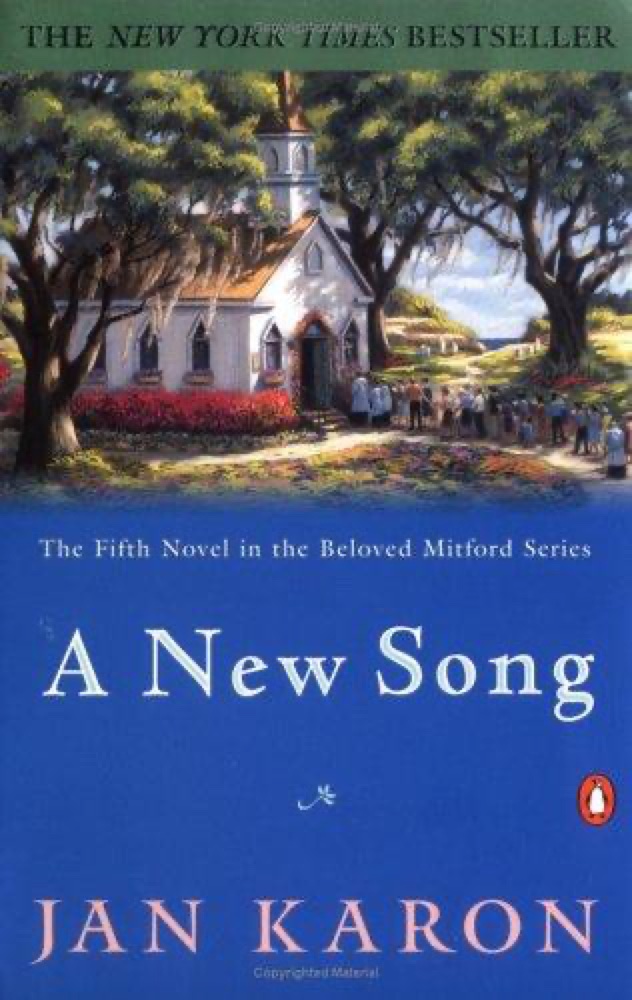

Quotes from A New Song

Jan Karon ·  576 pages

Rating: (17.6K votes)


“When the trees and the power lines crashed around you, when the very roof gave way above you, when the light turned to darkness and water turned to dust, did you call on Him?

When you called on Him, was He somewhere up there, or was He as near as your very breath?”
― Jan Karon, quote from A New Song


“Don’t feel totally, personally, irrevocably responsible for everything. That’s my job. Signed, God.”
― Jan Karon, quote from A New Song


“Be thankful for the smallest blessing,” Thomas à Kempis had written, “and you will deserve to receive greater. Value the least gifts no less than the greatest, and simple graces as especial favors. If you remember the dignity of the Giver, no gift will seem small or mean, for nothing can be valueless that is given by the most high God.” Father”
― Jan Karon, quote from A New Song


“A loved one from us has gone, A voice we love is stilled. A place is vacant in our home, Which never will be filled. Estelle Woodhouse, 1898-1987”
― Jan Karon, quote from A New Song


“The world is too much with us; late and soon,’ ” he said, quoting Wordsworth. “ ‘Getting and spending, we lay waste our powers;/ little we see in Nature that is ours;/ we have given our hearts away, a sordid boon!”
― Jan Karon, quote from A New Song


About the author

Jan Karon
Born place: in Lenoir, North Carolina, The United States
Born date January 1, 1937
See more on GoodReads

Popular quotes

“Love is no rose. It’s a goddamn weed that digs its roots in so deep, there’s no hope of getting it out.”
― Nalini Singh, quote from Silver Silence


“At the end of that class Demian said to me thoughtfully: "There’s something I don’t like about this story, Sinclair. Why don’t you read it once more and give it the acid test? There’s something about it that doesn’t taste right. I mean the business with the two thieves. The three crosses standing next to each other on the hill are almost impressive, to be sure. But now comes this sentimental little treatise about the good thief. At first he was a thorough scoundrel, had committed all those awful things and God knows what else, and now he dissolves in tears and celebrates such a tearful feast of self-improvement and remorse! What’s the sense of repenting if you’re two steps from the grave? I ask you. Once again, it’s nothing but a priest’s fairy tale, saccharine and dishonest, touched up with sentimentality and given a high edifying background. If you had to pick a friend from between the two thieves or decide which one you’d rather trust, you most certainly wouldn’t choose the sniveling convert. No, the other fellow, he’s a man of character. He doesn’t give a hoot for ‘conversion’, which to a man in his position can’t be anything but a pretty speech. He follows his destiny to it’s appointed end and does not turn coward and forswear the devil, who has aided and abetted him until then. He has character, and people with character tend to receive the short end of the stick in biblical stories. Perhaps he’s even a descendant of Cain. Don’t you agree?"

I was dismayed. Until now I had felt completely at home in the story of the Crucifixion. Now I saw for the first time with how little individuality, with how little power of imagination I had listened to it and read it. Still, Demian’s new concept seemed vaguely sinister and threatened to topple beliefs on whose continued existence I felt I simply had to insist. No, one could not make light of everything, especially not of the most Sacred matters.

As usual he noticed my resistance even before I had said anything.

"I know," he said in a resigned tone of voice, "it’s the same old story: don’t take these stories seriously! But I have to tell you something: this is one of the very places that reveals the poverty of this religion most distinctly. The point is that this God of both Old and New Testaments is certainly an extraordinary figure but not what he purports to represent. He is all that is good, noble, fatherly, beautiful, elevated, sentimental—true! But the world consists of something else besides. And what is left over is ascribed to the devil, this entire slice of world, this entire half is hushed up. In exactly the same way they praise God as the father of all life but simply refuse to say a word about our sexual life on which it’s all based, describing it whenever possible as sinful, the work of the devil. I have no objection to worshiping this God Jehovah, far from it. But I mean we ought to consider everything sacred, the entire world, not merely this artificially separated half! Thus alongside the divine service we should also have a service for the devil. I feel that would be right. Otherwise you must create for yourself a God that contains the devil too and in front of which you needn’t close your eyes when the most natural things in the world take place.”
― Hermann Hesse, quote from Demian


“Water, running - It was observed in ancient times that ghosts dislike crossing running water. In modern Britain this knowledge is sometimes used against them. In central London a net of artificial channels, or runnels, protects the main shopping district. On a smaller scale, some house-owners build open channels outside their front doors and divert the rainwater along them.”
― Jonathan Stroud, quote from Die Seufzende Wendeltreppe


“And are we not guilty of offensive disparagement in calling chess a game? Is it not also a science and an art, hovering between those categories as Muhammad’s coffin hovered between heaven and earth, a unique link between pairs of opposites: ancient yet eternally new; mechanical in structure, yet made effective only by the imagination; limited to a geometrically fixed space, yet with unlimited combinations; constantly developing, yet sterile; thought that leads nowhere; mathematics calculating nothing; art without works of art; architecture without substance – but nonetheless shown to be more durable in its entity and existence than all books and works of art; the only game that belongs to all nations and all eras, although no one knows what god brought it down to earth to vanquish boredom, sharpen the senses and stretch the mind. Where does it begin and where does it end? Every child can learn its basic rules, every bungler can try his luck at it, yet within that immutable little square it is able to bring forth a particular species of masters who cannot be compared to anyone else, people with a gift solely designed for chess, geniuses in their specific field who unite vision, patience and technique in just the same proportions as do mathematicians, poets, musicians, but in different stratifications and combinations. In the old days of the enthusiasm for physiognomy, a physician like Gall might perhaps have dissected a chess champion’s brain to find out whether some particular twist or turn in the grey matter, a kind of chess muscle or chess bump, is more developed in such chess geniuses than in the skulls of other mortals. And how intrigued such a physiognomist would have been by the case of Czentovic, where that specific genius appeared in a setting of absolute intellectual lethargy, like a single vein of gold in a hundredweight of dull stone. In principle, I had always realized that such a unique, brilliant game must create its own matadors, but how difficult and indeed impossible it is to imagine the life of an intellectually active human being whose world is reduced entirely to the narrow one-way traffic between black and white, who seeks the triumphs of his life in the mere movement to and fro, forward and back of thirty-two chessmen, someone to whom a new opening, moving knight rather than pawn, is a great deed, and his little corner of immortality is tucked away in a book about chess – a human being, an intellectual human being who constantly bends the entire force of his mind on the ridiculous task of forcing a wooden king into the corner of a wooden board, and does it without going mad!”
― Stefan Zweig, quote from Schachnovelle


“But I will not stand in front of your happiness. I will not even stand in front of misery that you choose for yourself.”
― Holly Black, quote from The Cruel Prince


Interesting books

The Canterville Ghost
(32.3K)
The Canterville Ghos...
by Oscar Wilde
Thus Spake Zarathustra
(83.7K)
Thus Spake Zarathust...
by Friedrich Nietzsche
Midnight
(27.6K)
Midnight
by Erin Hunter
Don't Let's Go to the Dogs Tonight
(43.3K)
Don't Let's Go to th...
by Alexandra Fuller
Kiss of Snow
(23.6K)
Kiss of Snow
by Nalini Singh
Rumo & His Miraculous Adventures
(7.2K)
Rumo & His Miraculou...
by Walter Moers

About BookQuoters

BookQuoters is a community of passionate readers who enjoy sharing the most meaningful, memorable and interesting quotes from great books. As the world communicates more and more via texts, memes and sound bytes, short but profound quotes from books have become more relevant and important. For some of us a quote becomes a mantra, a goal or a philosophy by which we live. For all of us, quotes are a great way to remember a book and to carry with us the author’s best ideas.

We thoughtfully gather quotes from our favorite books, both classic and current, and choose the ones that are most thought-provoking. Each quote represents a book that is interesting, well written and has potential to enhance the reader’s life. We also accept submissions from our visitors and will select the quotes we feel are most appealing to the BookQuoters community.

Founded in 2023, BookQuoters has quickly become a large and vibrant community of people who share an affinity for books. Books are seen by some as a throwback to a previous world; conversely, gleaning the main ideas of a book via a quote or a quick summary is typical of the Information Age but is a habit disdained by some diehard readers. We feel that we have the best of both worlds at BookQuoters; we read books cover-to-cover but offer you some of the highlights. We hope you’ll join us.