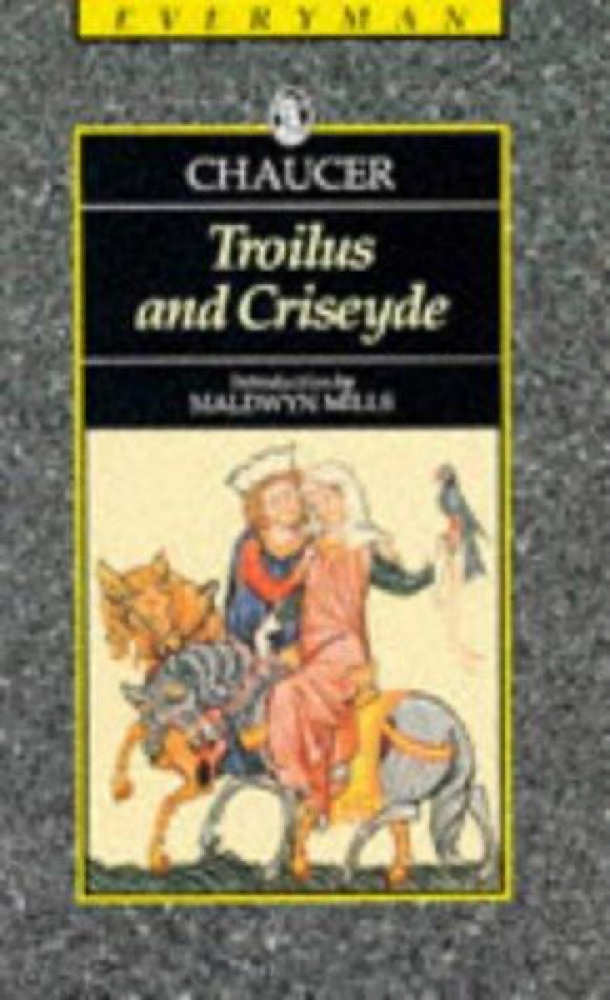


Quotes from Troilus and Criseyde

Geoffrey Chaucer ·  368 pages

Rating: (5.3K votes)


“Thus in this heaven he took his delight And smothered her with kisses upon kisses Till gradually he came to know where bliss is.”
― Geoffrey Chaucer, quote from Troilus and Criseyde


“Men may the wise atrenne, and naught atrede.”
― Geoffrey Chaucer, quote from Troilus and Criseyde


“For thus men seyth, "That on thenketh the beere,
But al another thenketh his ledere.”
― Geoffrey Chaucer, quote from Troilus and Criseyde


“And after winter folweth grene May.”
― Geoffrey Chaucer, quote from Troilus and Criseyde


“Ne nevere mo ne lakked hire pite;
Tendre-herted, slydynge of corage;
But trewely, I kan nat telle hire age.”
― Geoffrey Chaucer, quote from Troilus and Criseyde


“Go litel bok, go, litel myn tragedye,
Ther God thi makere yet, er that he dye,
So sende myght to make in som comedye!
But litel book, no makyng thow n'envie,
But subgit be to alle poesye;
And kis the steppes where as thow seest pace
Virgile, Ovide, Omer, Lucan, and Stace.”
― Geoffrey Chaucer, quote from Troilus and Criseyde


“Go, litel bok, go, litel myn tragedye,”
― Geoffrey Chaucer, quote from Troilus and Criseyde


About the author

Geoffrey Chaucer
Born place: London, England
See more on GoodReads

Popular quotes

“Erica…I love you…all of you. Even your scars.”
― Meredith Wild, quote from Hard Limit


“On this particular day her father, the vicar of a parish on the sea-swept outskirts of Lower Wessex, and a widower, was suffering from an attack of gout. After finishing her household supervision Elfride became restless, and several times left the room, ascended the staircase, and knocked at her father's chamber-door.
'Come in!' was always answered in a heart out-of-door voice from the inside.
'Papa,' she said on one occasion to the fine, red-faced, handsome man of forty, who, puffing and fizzing like a bursting bottle, lay on the bed wrapped in a dressing-gown, and every now and then enunciating, in spite of himself, about one letter of some word or words that were almost oaths; 'papa, will you not come downstairs this evening?' She spoke distinctly: he was rather deaf.
'Afraid not - eh-h-h! - very much afraid I shall not, Elfride. Piph-ph-ph! I can't bear even a handkerchief upon this deuced toe of mine, much less a stocking or slipper - piph-ph-ph! There 'tis again! No, I shan't get up till tomorrow.'
'Then I hope this London man won't come; for I don't know what I should do, papa.'
'Well, it would be awkward, certainly.'
'I should hardly think he would come today.'
'Why?'
'Because the wind blows so.'
'Wind! What ideas you have, Elfride! Who ever heard of wind stopping a man from doing his business? The idea of this toe of mine coming on so suddenly!... If he should come, you must send him up to me, I suppose, and then give him some food and put him to bed in some way. Dear me, what a nuisance all this is!'
'Must he have dinner?'
'Too heavy for a tired man at the end of a tedious journey.'
'Tea, then?'
'Not substantial enough.'
'High tea, then? There is cold fowl, rabbit-pie, some pasties, and things of that kind.'
'Yes, high tea.'
'Must I pour out his tea, papa?'
'Of course; you are the mistress of the house.'
'What! sit there all the time with a stranger, just as if I knew him, and not anybody to introduce us?'
'Nonsense, child, about introducing; you know better than that. A practical professional man, tired and hungry, who has been travelling ever since daylight this morning, will hardly be inclined to talk and air courtesies tonight. He wants food and shelter, and you must see that he has it, simply because I am suddenly laid up and cannot. There is nothing so dreadful in that, I hope? You get all kinds of stuff into your head from reading so many of those novels.”
― Thomas Hardy, quote from A Pair of Blue Eyes


“Tibet has not yet been infested by the worst disease of modern life, the everlasting rush. No one overworks here. Officials have an easy life. They turn up at the office late in the morning and leave for their homes early in the afternoon. If an official has guests or any other reason for not coming, he just sends a servant to a colleague and asks him to officiate for him.
Women know nothing about equal rights and are quite happy as they are. They spend hours making up their faces, restringing their pearl necklaces, choosing new material for dresses, and thinking how to outshine Mrs. So-and-so at the next party. They do not have to bother about housekeeping, which is all done by the servants. But to show that she is mistress the lady of the house always carries a large bunch of keys around with her. In Lhasa every trifling object is locked up and double-locked.
Then there is mah-jongg. At one time this game was a universal passion. People were simply fascinated by it and played it day and night, forgetting everything else—official duties, housekeeping, the family. The stakes were often very high and everyone played—even the servants, who sometimes contrived to lose in a few hours what they had taken years to save. Finally the government found it too much of a good thing. They forbade the game, bought up all the mah-jongg sets, and condemned secret offenders to heavy fines and hard labor. And they brought it off! I would never have believed it, but though everyone moaned and hankered to play again, they respected the prohibition. After mah-jongg had been stopped, it became gradually evident how everything else had been neglected during the epidemic. On Saturdays—the day of rest—people now played chess or halma, or occupied themselves harmlessly with word games and puzzles.”
― Heinrich Harrer, quote from Seven Years in Tibet (Paladin Books)


“Las referencias feroces, aunque vagas, que escuchaba en boca de los cadetes, estimulaban su imaginación. En sueños, el nombre se presentaba dotado de atributos carnales, extraños y contradictorios, la mujer era siempre la misma y distinta, una presencia que se desvanecía cuando iba a tocarla o lo sumía en una ternura infinita y entonces creía morir de impaciencia.”
― Mario Vargas Llosa, quote from The Time of the Hero


“It was against this backdrop that the great fortunes were made, fortunes which allowed the first families to dominate the society of that era. Theodore Parker, a crusading minister in the 1840s, wrote of the Lowells and these other great families: “This class is the controlling one in politics. It mainly enacts the laws of this state and the nation; makes them serve its turn . . . It can manufacture governors, senators, judges to suit its purposes as easily as it can manufacture cotton cloth. This class owns the machinery of society . . . ships, factories, shops, water privileges.” They were also families which had a fine sense of protecting their own position, and they were notorious for giving large grants to Harvard College, which was their college, and just as notorious for doing very little for public education.”
― David Halberstam, quote from The Best and the Brightest


Interesting books

The Lost Language of Cranes
(5K)
The Lost Language of...
by David Leavitt
The Confessions of Max Tivoli
(5.9K)
The Confessions of M...
by Andrew Sean Greer
Edwin Mullhouse: The Life and Death of an American Writer 1943-1954 by Jeffrey Cartwright
(784)
Edwin Mullhouse: The...
by Steven Millhauser
The Guns of Avalon
(17.3K)
The Guns of Avalon
by Roger Zelazny
From Beirut to Jerusalem
(9K)
The Ghost Map: The Story of London's Most Terrifying Epidemic - and How It Changed Science, Cities, and the Modern World
(29.8K)
The Ghost Map: The S...
by Steven Johnson

About BookQuoters

BookQuoters is a community of passionate readers who enjoy sharing the most meaningful, memorable and interesting quotes from great books. As the world communicates more and more via texts, memes and sound bytes, short but profound quotes from books have become more relevant and important. For some of us a quote becomes a mantra, a goal or a philosophy by which we live. For all of us, quotes are a great way to remember a book and to carry with us the author’s best ideas.

We thoughtfully gather quotes from our favorite books, both classic and current, and choose the ones that are most thought-provoking. Each quote represents a book that is interesting, well written and has potential to enhance the reader’s life. We also accept submissions from our visitors and will select the quotes we feel are most appealing to the BookQuoters community.

Founded in 2023, BookQuoters has quickly become a large and vibrant community of people who share an affinity for books. Books are seen by some as a throwback to a previous world; conversely, gleaning the main ideas of a book via a quote or a quick summary is typical of the Information Age but is a habit disdained by some diehard readers. We feel that we have the best of both worlds at BookQuoters; we read books cover-to-cover but offer you some of the highlights. We hope you’ll join us.