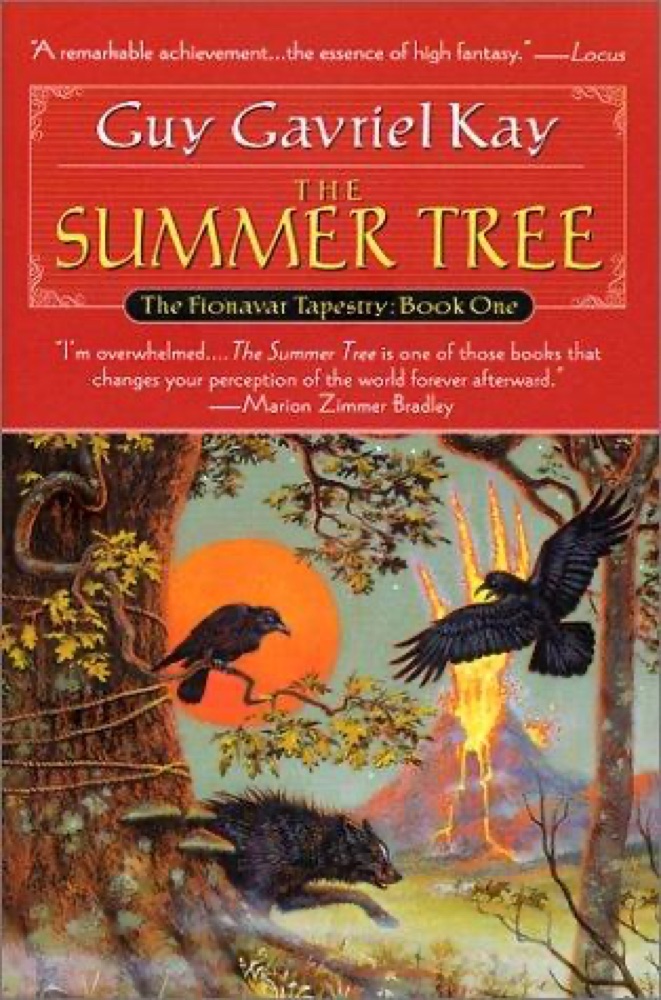

Quotes from The Summer Tree

Guy Gavriel Kay ·  383 pages

Rating: (18.6K votes)


“There are kinds of action, for good or ill, that lie so far outside the boundaries of normal behavior that they force us, in acknowledging that they have occurred, to restructure our own understanding of reality. We have to make room for them.”
― Guy Gavriel Kay, quote from The Summer Tree


“We salvage what we can, what truly matters to us, even at the gates of despair.”
― Guy Gavriel Kay, quote from The Summer Tree


“Dave hung up. And unplugged the phone. With a fierce and bitter pain he stared at it, watching how, over and over again, it didn't ring.”
― Guy Gavriel Kay, quote from The Summer Tree


“One didn't stop to talk with creatures from one's nightmares.”
― Guy Gavriel Kay, quote from The Summer Tree


“Daylight was coming outside, but it was not only that: courage cast its own light.”
― Guy Gavriel Kay, quote from The Summer Tree


“For some moments the two men sat quietly, each wrapped in his own thoughts, then Ivor rose. 'I should speak to Levon about tomorrow's hunt,' he said. 'Sixteen [eltors], I think.'

'At least,' the shaman said in an aggrieved tone. 'I could eat a whole one myself. We haven't feasted in a long time, Ivor.'

Ivor snorted. 'A very long time, you greedy old man. Twelve whole days...why aren't you fat?'

'Becaues,' the wisest one explained patiently, 'you never have enough food at the feasts.”
― Guy Gavriel Kay, quote from The Summer Tree


“But courage was not lacking in her heart, though it might be foolhardy and unwise.”
― Guy Gavriel Kay, quote from The Summer Tree


“Alluding and attacking, summoning a courage, embodying a gallantry of defiance that hurt to see, it was so noble and so doomed.”
― Guy Gavriel Kay, quote from The Summer Tree


About the author

Guy Gavriel Kay
Born place: in Weyburn, Saskatchewan, Canada
See more on GoodReads

Popular quotes

“it is not uncommon for experts in DNA analysis to testify at a criminal trial that a DNA sample taken from a crime scene matches that taken from a suspect. How certain are such matches? When DNA evidence was first introduced, a number of experts testified that false positives are impossible in DNA testing. Today DNA experts regularly testify that the odds of a random person’s matching the crime sample are less than 1 in 1 million or 1 in 1 billion. With those odds one could hardly blame a juror for thinking, throw away the key. But there is another statistic that is often not presented to the jury, one having to do with the fact that labs make errors, for instance, in collecting or handling a sample, by accidentally mixing or swapping samples, or by misinterpreting or incorrectly reporting results. Each of these errors is rare but not nearly as rare as a random match. The Philadelphia City Crime Laboratory, for instance, admitted that it had swapped the reference sample of the defendant and the victim in a rape case, and a testing firm called Cellmark Diagnostics admitted a similar error.20 Unfortunately, the power of statistics relating to DNA presented in court is such that in Oklahoma a court sentenced a man named Timothy Durham to more than 3,100 years in prison even though eleven witnesses had placed him in another state at the time of the crime. It turned out that in the initial analysis the lab had failed to completely separate the DNA of the rapist and that of the victim in the fluid they tested, and the combination of the victim’s and the rapist’s DNA produced a positive result when compared with Durham’s. A later retest turned up the error, and Durham was released after spending nearly four years in prison.21 Estimates of the error rate due to human causes vary, but many experts put it at around 1 percent. However, since the error rate of many labs has never been measured, courts often do not allow testimony on this overall statistic. Even if courts did allow testimony regarding false positives, how would jurors assess it? Most jurors assume that given the two types of error—the 1 in 1 billion accidental match and the 1 in 100 lab-error match—the overall error rate must be somewhere in between, say 1 in 500 million, which is still for most jurors beyond a reasonable doubt. But employing the laws of probability, we find a much different answer. The way to think of it is this: Since both errors are very unlikely, we can ignore the possibility that there is both an accidental match and a lab error. Therefore, we seek the probability that one error or the other occurred. That is given by our sum rule: it is the probability of a lab error (1 in 100) + the probability of an accidental match (1 in 1 billion). Since the latter is 10 million times smaller than the former, to a very good approximation the chance of both errors is the same as the chance of the more probable error—that is, the chances are 1 in 100. Given both possible causes, therefore, we should ignore the fancy expert testimony about the odds of accidental matches and focus instead on the much higher laboratory error rate—the very data courts often do not allow attorneys to present! And so the oft-repeated claims of DNA infallibility are exaggerated.”
― Leonard Mlodinow, quote from The Drunkard's Walk: How Randomness Rules Our Lives


“I stand guard,” Yasha said. He got out of the SUV and pulled a sawed-off shotgun out from under his seat.
“And keep our exit open,” Ian told him.
Yasha grinned crookedly. “Don’t I always?” He looked at me and his grin broadened. “Scream if something jumps at you.”
I tried for a grin; it felt more like a grimace. “Don’t I always?”
― Lisa Shearin, quote from The Grendel Affair


“Immediately Trent went back to mowing down those cookies, slowing when he realized I was staring at him. What are we up to now? Ten?”
― Kim Harrison, quote from The Witch With No Name


“I believe in happiness. I'm just not sure love will actually get you there.”
― Katharine McGee, quote from The Thousandth Floor


“And her mother still struggled in these white kitchens in town, humming sweet hymns, tiny, mild eyed and bent, her father still labored on the oyster boats; after a lifetime of labor, should they drop dead tomorrow, there would not be a penny for their burial clothes.”
― James Baldwin, quote from Going to Meet the Man


Interesting books

Come Unto These Yellow Sands
(2.9K)
Come Unto These Yell...
by Josh Lanyon
Incendiary
(11.4K)
Incendiary
by Chris Cleave
The Art of Always Being Right
(4.9K)
The Art of Always Be...
by Arthur Schopenhauer
Arena One: Slaverunners
(4.9K)
Arena One: Slaverunn...
by Morgan Rice
Abide with Me
(7.9K)
Abide with Me
by Elizabeth Strout
The Good Life
(808)
The Good Life
by Jodie Beau

About BookQuoters

BookQuoters is a community of passionate readers who enjoy sharing the most meaningful, memorable and interesting quotes from great books. As the world communicates more and more via texts, memes and sound bytes, short but profound quotes from books have become more relevant and important. For some of us a quote becomes a mantra, a goal or a philosophy by which we live. For all of us, quotes are a great way to remember a book and to carry with us the author’s best ideas.

We thoughtfully gather quotes from our favorite books, both classic and current, and choose the ones that are most thought-provoking. Each quote represents a book that is interesting, well written and has potential to enhance the reader’s life. We also accept submissions from our visitors and will select the quotes we feel are most appealing to the BookQuoters community.

Founded in 2023, BookQuoters has quickly become a large and vibrant community of people who share an affinity for books. Books are seen by some as a throwback to a previous world; conversely, gleaning the main ideas of a book via a quote or a quick summary is typical of the Information Age but is a habit disdained by some diehard readers. We feel that we have the best of both worlds at BookQuoters; we read books cover-to-cover but offer you some of the highlights. We hope you’ll join us.