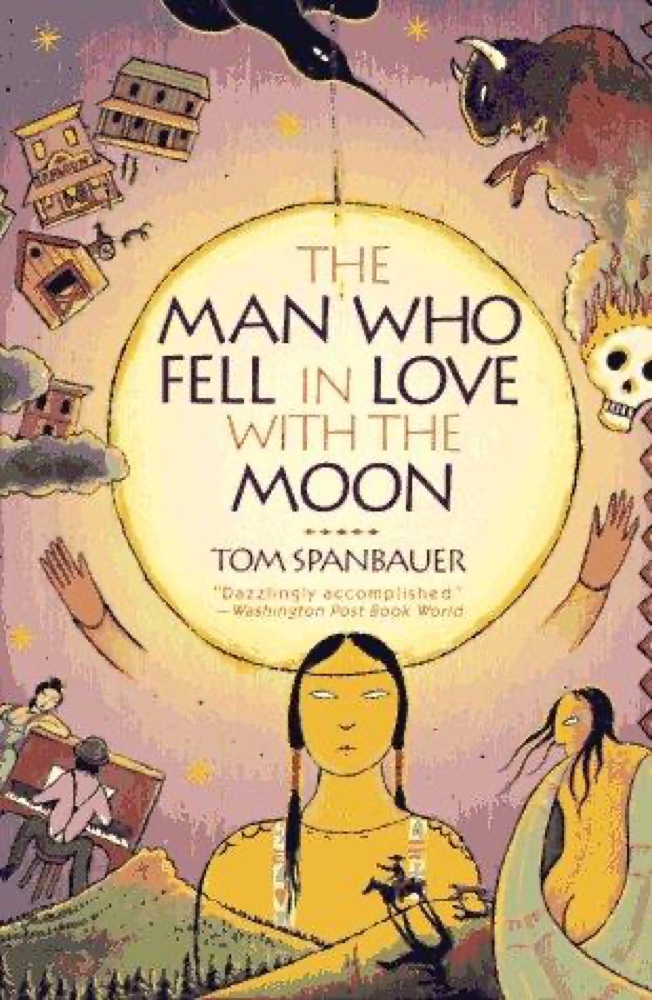

Quotes from The Man Who Fell in Love with the Moon

Tom Spanbauer ·  368 pages

Rating: (2.4K votes)


“Looking for who I am is who I am.”
― Tom Spanbauer, quote from The Man Who Fell in Love with the Moon


“A person without her or his own truth ain't a person at all, Ida said. Anybody who tells you different—is a jackass, and no longer deserves to be called human being.”
― Tom Spanbauer, quote from The Man Who Fell in Love with the Moon


“I tell you I'm tired of hearing it. There ain't nothing that happens to a person that ain't that person. The world out there only does what you tell it to do. The world is happening to you the way it is happening because you're telling yourself the story that way. If you want to change the world so damn bad, Ida, then where you got to start is how it is you're looking at it.”
― Tom Spanbauer, quote from The Man Who Fell in Love with the Moon


“With tybo men there isn't much difference between fucking and killing.”
― Tom Spanbauer, quote from The Man Who Fell in Love with the Moon


“Felt good, though, just being what I was.”
― Tom Spanbauer, quote from The Man Who Fell in Love with the Moon


About the author

Tom Spanbauer
Born place: Pocatello, Idaho, The United States
See more on GoodReads

Popular quotes

“I say that humans are the only ones in this world that need everything within it...But there is nothing in the world that needs us for its survival. We aren't the masters of the earth. We're the servants.”
― Joseph Boyden, quote from The Orenda


“Being a hero means ignoring how silly you feel.”
― Diana Wynne Jones, quote from Fire and Hemlock


“Studentdom, he felt, must pass its own Examinations and define its own Commencement--a slow, most painful process, made the more anguishing by bloody intelligences like the Bonifacists of Siegfrieder College. Yet however it seemed at times that men got nowhere, but only repeated class by class the mistakes of their predecessors, two crucial facts about them were at once their hope and the limitation of their possibility, so he believed. One was their historicity: the campus was young, the student race even younger, and by contrast with the whole of past time, the great collegiate cultures had been born only yesterday. The other had to do with comparative cyclology, a field of systematic speculation he could not review for me just then, but whose present relevance lay in the correspondency he held to obtain between the life-history of individuals and the history of studentdom in general. As the embryologists maintained that ontogeny repeats phylogeny, so, Max claimed, the race itself--and on a smaller scale, West-Campus culture--followed demonstrably--in capital letters, as it were, or slow motion--the life-pattern of its least new freshman. This was the basis of Spielman's Law--ontogeny repeats cosmogeny--and there was much more to it and to the science of cyclology whereof it was first principle. The important thing for now was that, by his calculations, West-Campus as a whole was in mid-adolescence...
'Look how we been acting,' he invited me, referring to intercollegiate political squabbles; 'the colleges are spoilt kids, and the whole University a mindless baby, ja? Okay: so weren't we all once, Enos Enoch too? And we got to admit that the University's a precocious kid. If the history of life on campus hadn't been so childish, we couldn't hope it'll reach maturity.' Studentdom had passed already, he asserted, from a disorganized, pre-literate infancy (of which Croaker was a modern representative, nothing ever being entirely lost) through a rather brilliant early childhood ('...ancient Lykeion, Remus, T'ang...') which formed its basic and somewhat contradictory character; it had undergone a period of naive general faith in parental authority (by which he meant early Founderism) and survived critical spells of disillusionment, skepticism, rationalism, willfulness, self-criticism, violence, disorientation, despair, and the like--all characteristic of pre-adolescence and adolescence, at least in their West-Campus form. I even recognized some of those stages in my own recent past; indeed, Max's description of the present state of West-Campus studentdom reminded me uncomfortably of my behavior in the Lady-Creamhair period: capricious, at odds with itself, perverse, hard to live with. Its schisms, as manifested in the Quiet Riot, had been aggravated and rendered dangerous by the access of unwonted power--as when, in the space of a few semesters, a boy finds himself suddenly muscular, deep-voiced, aware of his failings, proud of his strengths, capable of truly potent love and hatred--and on his own. What hope there was that such an adolescent would reach maturity (not to say Commencement) without destroying himself was precisely the hope of the University.”
― John Barth, quote from Giles Goat-Boy


“The line it is drawn
The curse it is cast
The slow one now
Will later be fast
As the present now
Will later be past
The new order is
Rapidly fadin'.
And the first one now
Will later be last
For the times they are a-changin'.”
― Bob Dylan, quote from Chronicles, Volume One


“Thomas More: Will, I'd trust you with my life. But not your principles. You see, we speak of being anchored to our principles. But if the weather turns nasty you up with an anchor and let it down where there's less wind, and the fishing's better. And "Look," we say, "look, I'm anchored! To my principles!”
― Robert Bolt, quote from A Man for All Seasons


Interesting books

Secret Teachings of All Ages: An Encyclopedic Outline of Masonic, Hermetic, Quabbalistic, and Ro
(3K)
Secret Teachings of...
by Manly P. Hall
Heartsnatcher
(3.7K)
Heartsnatcher
by Boris Vian
Old Magic
(9.6K)
Old Magic
by Marianne Curley
A Land More Kind Than Home
(20K)
A Land More Kind Tha...
by Wiley Cash
Justine
(5.6K)
Justine
by Lawrence Durrell
A Note of Madness
(854)
A Note of Madness
by Tabitha Suzuma

About BookQuoters

BookQuoters is a community of passionate readers who enjoy sharing the most meaningful, memorable and interesting quotes from great books. As the world communicates more and more via texts, memes and sound bytes, short but profound quotes from books have become more relevant and important. For some of us a quote becomes a mantra, a goal or a philosophy by which we live. For all of us, quotes are a great way to remember a book and to carry with us the author’s best ideas.

We thoughtfully gather quotes from our favorite books, both classic and current, and choose the ones that are most thought-provoking. Each quote represents a book that is interesting, well written and has potential to enhance the reader’s life. We also accept submissions from our visitors and will select the quotes we feel are most appealing to the BookQuoters community.

Founded in 2023, BookQuoters has quickly become a large and vibrant community of people who share an affinity for books. Books are seen by some as a throwback to a previous world; conversely, gleaning the main ideas of a book via a quote or a quick summary is typical of the Information Age but is a habit disdained by some diehard readers. We feel that we have the best of both worlds at BookQuoters; we read books cover-to-cover but offer you some of the highlights. We hope you’ll join us.