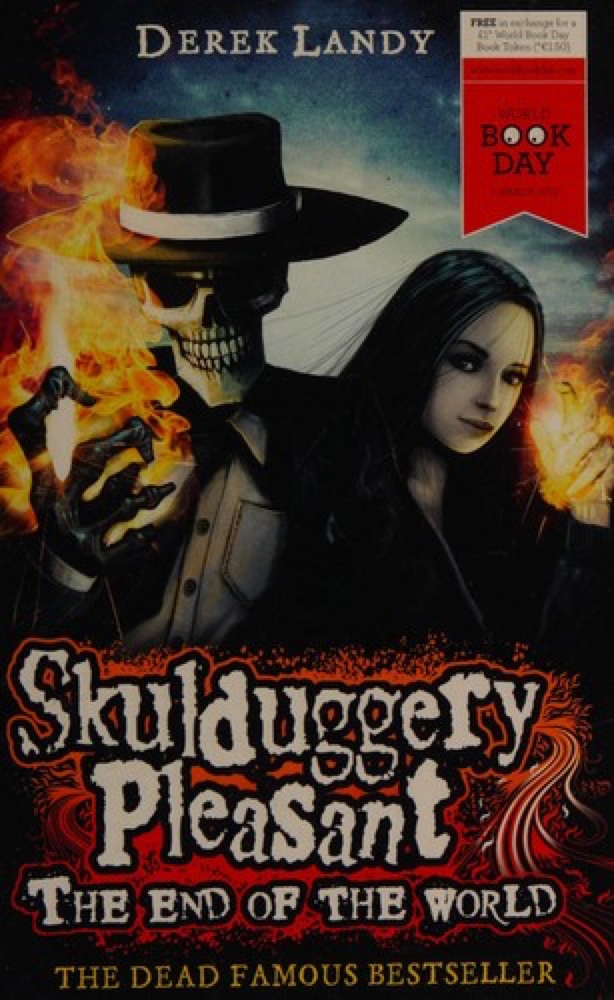

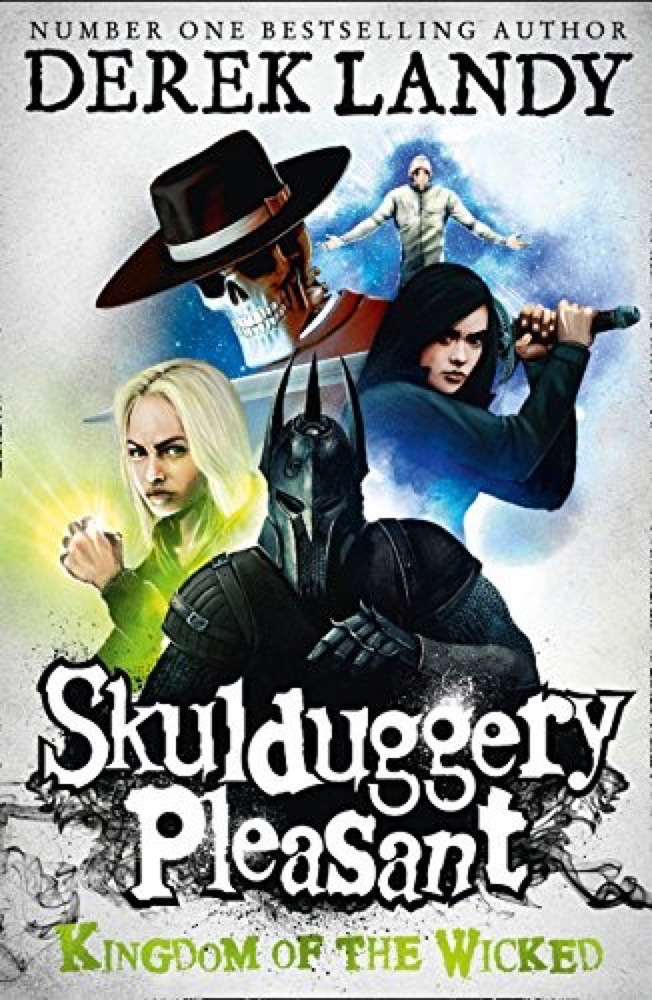
Quotes from The End of the World

Derek Landy ·  128 pages

Rating: (4.5K votes)


“We're not robbing him," Skulduggery said." But I'm afraid I have some bad news."
"Is it Deacon?" Francine asked, her eyes wide.
"It is."
"Is he sick?"
"It's a little worse than that."
She gasped. "He's dying?"
"He was briefly dying," said Skulduggery. "Now he's dead.”
― Derek Landy, quote from The End of the World


“Valkyrie made a face. "Bloody vampires."
Ryan sat forward. "That was a vampire? That guy who looked like an accountant?"

"We don't talk about vampires," Skulduggery warned.
"But it was daytime. How could he have been out during the-"
"We don't talk about vampires!" Valkyrie said sharply.

Ryan shrunk back. "Sorry," he said.
"Don't worry about it," Skulduggery told him. "Valkyrie used to date a vampire that's all."

"We didn't date ," Valkyrie said immediately.
Skulduggery held a hand up. "I'm not judging."

Valkyrie scowled.”
― Derek Landy, quote from The End of the World


“The workshop door opened and Skulduggery emerged. "Ryan," he said, "stop leaning on my car.”
― Derek Landy, quote from The End of the World


“I’ve got good news and bad news for you, Ryan. The bad news is that you’re the only one in the world who can activate the Doomsday Machine, and Foe and his gang are never going to stop coming after you. The good news is that with myself and Valkyrie protecting you, you stand a very good chance of emerging from this relatively unscathed.”

Valkyrie looked at the back of Skulduggery’s head. “You said they’d probably try to cut his hand off.”

“I said relatively,” Skulduggery reminded her.”
― Derek Landy, quote from The End of the World


“He was so strong,” Francine sobbed. “So proud. So much dignity. How did he die?”

“Wood chipper,” said Valkyrie.”
― Derek Landy, quote from The End of the World


“Ryan, you're not real. You don't exist... You're Deacon Maybury," Skulduggery said. "You're a hiding place who thinks it's a boy.”
― Derek Landy, quote from The End of the World


About the author

Derek Landy
Born place: in Lusk, Ireland
Born date October 23, 1974
See more on GoodReads

Popular quotes

“It is what is. I repeated, looking at him in the eyes. No. It isn't. That's stupidity right up there with 'failure is not an option.' Of course it's an option or there wouldn't be any sort of adventure to it, would there? The word 'adventure' means undetermined outcome, did you know that? So failure would have to be an option, right?”
― Josh Hanagarne, quote from The World's Strongest Librarian: A Memoir of Tourette's, Faith, Strength, and the Power of Family


“The history of black workers in the United States illustrates the point. As already noted, from the late nineteenth-century on through the middle of the twentieth century, the labor force participation rate of American blacks was slightly higher than that of American whites. In other words, blacks were just as employable at the wages they received as whites were at their very different wages. The minimum wage law changed that. Before federal minimum wage laws were instituted in the 1930s, the black unemployment rate was slightly lower than the white unemployment rate in 1930. But then followed the Davis-Bacon Act of 1931, the National Industrial Recovery Act of 1933 and the Fair Labor Standards Act of 1938—all of which imposed government-mandated minimum wages, either on a particular sector or more broadly. The National Labor Relations Act of 1935, which promoted unionization, also tended to price black workers out of jobs, in addition to union rules that kept blacks from jobs by barring them from union membership. The National Industrial Recovery Act raised wage rates in the Southern textile industry by 70 percent in just five months and its impact nationwide was estimated to have cost blacks half a million jobs. While this Act was later declared unconstitutional by the Supreme Court, the Fair Labor Standards Act of 1938 was upheld by the High Court and became the major force establishing a national minimum wage. As already noted, the inflation of the 1940s largely nullified the effect of the Fair Labor Standards Act, until it was amended in 1950 to raise minimum wages to a level that would have some actual effect on current wages. By 1954, black unemployment rates were double those of whites and have continued to be at that level or higher. Those particularly hard hit by the resulting unemployment have been black teenage males. Even though 1949—the year before a series of minimum wage escalations began—was a recession year, black teenage male unemployment that year was lower than it was to be at any time during the later boom years of the 1960s. The wide gap between the unemployment rates of black and white teenagers dates from the escalation of the minimum wage and the spread of its coverage in the 1950s. The usual explanations of high unemployment among black teenagers—inexperience, less education, lack of skills, racism—cannot explain their rising unemployment, since all these things were worse during the earlier period when black teenage unemployment was much lower. Taking the more normal year of 1948 as a basis for comparison, black male teenage unemployment then was less than half of what it would be at any time during the decade of the 1960s and less than one-third of what it would be in the 1970s. Unemployment among 16 and 17-year-old black males was no higher than among white males of the same age in 1948. It was only after a series of minimum wage escalations began that black male teenage unemployment not only skyrocketed but became more than double the unemployment rates among white male teenagers. In the early twenty-first century, the unemployment rate for black teenagers exceeded 30 percent. After the American economy turned down in the wake of the housing and financial crises, unemployment among black teenagers reached 40 percent.”
― Thomas Sowell, quote from Basic Economics: A Citizen's Guide to the Economy


“Simplicity is the shortest distance between two points.”
― Bruce Lee, quote from Tao of Jeet Kune Do


“His eyes lingered on me, and I wondered if that was a message. Was he danger? Was I supposed to run?

I wasn’t afraid.”
― Abigail Haas, quote from Dangerous Boys


“I've never been good at emotional stuff. Except anger. Anger, I'm good at.”
― Hannah Harrington, quote from Saving June


Interesting books

Academ's Fury
(51.3K)
Academ's Fury
by Jim Butcher
Emblaze
(9.9K)
Emblaze
by Jessica Shirvington
Cosmicomics
(12.3K)
Cosmicomics
by Italo Calvino
Inés of My Soul
(18.5K)
Inés of My Soul
by Isabel Allende
Babbitt
(18.5K)
Babbitt
by Sinclair Lewis
Beauty from Pain
(51.3K)
Beauty from Pain
by Georgia Cates

About BookQuoters

BookQuoters is a community of passionate readers who enjoy sharing the most meaningful, memorable and interesting quotes from great books. As the world communicates more and more via texts, memes and sound bytes, short but profound quotes from books have become more relevant and important. For some of us a quote becomes a mantra, a goal or a philosophy by which we live. For all of us, quotes are a great way to remember a book and to carry with us the author’s best ideas.

We thoughtfully gather quotes from our favorite books, both classic and current, and choose the ones that are most thought-provoking. Each quote represents a book that is interesting, well written and has potential to enhance the reader’s life. We also accept submissions from our visitors and will select the quotes we feel are most appealing to the BookQuoters community.

Founded in 2023, BookQuoters has quickly become a large and vibrant community of people who share an affinity for books. Books are seen by some as a throwback to a previous world; conversely, gleaning the main ideas of a book via a quote or a quick summary is typical of the Information Age but is a habit disdained by some diehard readers. We feel that we have the best of both worlds at BookQuoters; we read books cover-to-cover but offer you some of the highlights. We hope you’ll join us.