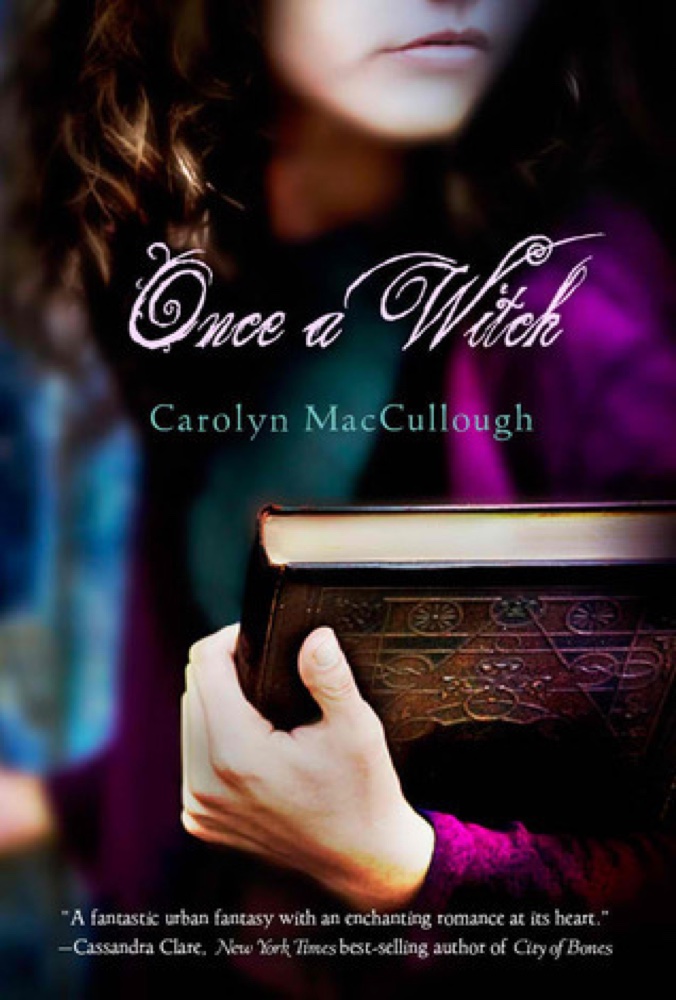

“I was born on the night of Samhain, when the barrier between the worlds is whisper-thin and when magic, old magic, sings its heady and sweet song to anyone who cares to hear it.”
― Carolyn MacCullough, quote from Once a Witch
“Please!" I stop my pacing, glare at him. "Is that all you can think about at a time like this?"
Gabriel rolls up on one elbow and smiles at me. "I'm a guy. It's what I think about all the time.”
― Carolyn MacCullough, quote from Once a Witch
“Okay," I gasp. "I can't really breathe, but other than that, okay."
"Breathing's overrated," Gabriel advises me."I'm discovering that right about now with this damn tie.”
― Carolyn MacCullough, quote from Once a Witch
“There. What do you think?" he takes half a step back and i look at myself in the mirror again. Somehow, he has managed where i failed to roll my hair an pin it low on my neck. The curl that keeps escaping has now been positioned behind my ear.
"Not bad," i say. "You know if the musician thing doesn't work out, you could always be a-"
Behind me Gabriel makes a stabbing motion over his heart.”
― Carolyn MacCullough, quote from Once a Witch
“Your father and I will deal with him.”
“What are you going to do?” I say.
“We will talk to him.”
I snort.
“Yeah, that's going to work.”
― Carolyn MacCullough, quote from Once a Witch
“You and I are more alike than you think,” Alistair says.
“I don't see that at all,” I say.
“Besides the fact that we both lied about our names,” I add.”
― Carolyn MacCullough, quote from Once a Witch
“Then one last thought tugs at me, so I turn back.
"So why did you name me Tamsin?" I ask. "You always promised to tell me later. Even though, technically, it's earlier."
My grandmother's smile flickers, deepens.
"It's how you introduced yourself to me tonight. I just assumed that's what you wanted to be named.”
― Carolyn MacCullough, quote from Once a Witch
“The Romans gave them Roman names, and let them be; but the Christians refuse to believe in them, and their priests berate the poorer folk for clinging to the old ways—and no doubt for wasting offerings which would do better at some hermit’s cell than at some ancient holy place in the forest. But still the simple folk creep out to leave their offerings, and when these vanish by morning, who is to say that a god has not taken them? This,”
― Mary Stewart, quote from The Hollow Hills
“I shan't ask you how you do, ma'am: to enquire after a lady's health implies that she is not in her best looks. Besides, I can see that you are in high bloom.”
― Georgette Heyer, quote from Black Sheep
“The Author of Her Misfortune"
I’m not the man she claims. But
this much is true: the past is
distant, a receding coastline,
and we’re all in the same boat,
a scrim of rain over the sea-lanes.
Still, I wish she wouldn’t keep on
saying those things about me!
Over the long course
everything but hope lets you go, then
even that loosens its grip.
There isn’t enough of anything
as long as we live. But at intervals
a sweetness appears and, given a chance,
prevails. It’s true I’m happy now.
And it’d be nice if she
could hold her tongue. Stop
hating me for being happy.
Blaming me for her life. I’m afraid
I’m mixed up in her mind
with someone else. A young man
of no character, living on dreams,
who swore he’d love her forever.
One who gave her a ring, and a bracelet.
Who said, Come with me. You can trust me.
Things to that effect. I’m not that man.
She has me confused, as I said,
with someone else.”
― Raymond Carver, quote from All of Us: The Collected Poems
“Under the seeming disorder of the old city, wherever the old city is working successfully, is a marvelous order for maintaining the safety of the streets and the freedom of the city. It is a complex order. Its essence is intricacy of sidewalk use, bringing with it a constant succession of eyes. This order is all composed of movement and change, and although it is life, not art, we may fancifully call it the art form of the city and liken it to the dance — not to a simple-minded precision dance with everyone kicking up at the same time, twirling in unison and bowing off en masse, but to an intricate ballet in which the individual dancers and ensembles all have distinctive parts which miraculously reinforce each other and compose an orderly whole. The ballet of the good city sidewalk never repeats itself from place to place, and in any once place is always replete with new improvisations.
The stretch of Hudson Street where I live is each day the scene of an intricate sidewalk ballet. I make my own first entrance into it a little after eight when I put out my garbage gcan, surely a prosaic occupation, but I enjoy my part, my little clang, as the junior droves of junior high school students walk by the center of the stage dropping candy wrapper. (How do they eat so much candy so early in the morning?)
While I sweep up the wrappers I watch the other rituals of the morning: Mr Halpert unlocking the laundry's handcart from its mooring to a cellar door, Joe Cornacchia's son-in-law stacking out the empty crates from the delicatessen, the barber bringing out his sidewalk folding chair, Mr. Goldstein arranging the coils of wire which proclaim the hardware store is open, the wife of the tenement's super intendent depositing her chunky three-year-old with a toy mandolin on the stoop, the vantage point from which he is learning English his mother cannot speak. Now the primary childrren, heading for St. Luke's, dribble through the south; the children from St. Veronica\s cross, heading to the west, and the children from P.S 41, heading toward the east. Two new entrances are made from the wings: well-dressed and even elegant women and men with brief cases emerge from doorways and side streets. Most of these are heading for the bus and subways, but some hover on the curbs, stopping taxis which have miraculously appeared at the right moment, for the taxis are part of a wider morning ritual: having dropped passengers from midtown in the downtown financial district, they are now bringing downtowners up tow midtown. Simultaneously, numbers of women in housedresses have emerged and as they crisscross with one another they pause for quick conversations that sound with laughter or joint indignation, never, it seems, anything in between. It is time for me to hurry to work too, and I exchange my ritual farewell with Mr. Lofaro, the short, thick bodied, white-aproned fruit man who stands outside his doorway a little up the street, his arms folded, his feet planted, looking solid as the earth itself. We nod; we each glance quickly up and down the street, then look back at eachother and smile. We have done this many a morning for more than ten years, and we both know what it means: all is well.
The heart of the day ballet I seldom see, because part off the nature of it is that working people who live there, like me, are mostly gone, filling the roles of strangers on other sidewalks. But from days off, I know enough to know that it becomes more and more intricate. Longshoremen who are not working that day gather at the White Horse or the Ideal or the International for beer and conversation. The executives and business lunchers from the industries just to the west throng the Dorgene restaurant and the Lion's Head coffee house; meat market workers and communication scientists fill the bakery lunchroom.”
― Jane Jacobs, quote from The Death and Life of Great American Cities
“Not to mention the loneliness. And at the same time, the crowdedness. The never being really alone, just to think, to rest or to do something private - anything private. You can`t even got to toilet in private. And if you want company, real company, not just people hanging about making a noise, that`s when you realize how lonely you are.”
― Meg Rosoff, quote from What I Was
BookQuoters is a community of passionate readers who enjoy sharing the most meaningful, memorable and interesting quotes from great books. As the world communicates more and more via texts, memes and sound bytes, short but profound quotes from books have become more relevant and important. For some of us a quote becomes a mantra, a goal or a philosophy by which we live. For all of us, quotes are a great way to remember a book and to carry with us the author’s best ideas.
We thoughtfully gather quotes from our favorite books, both classic and current, and choose the ones that are most thought-provoking. Each quote represents a book that is interesting, well written and has potential to enhance the reader’s life. We also accept submissions from our visitors and will select the quotes we feel are most appealing to the BookQuoters community.
Founded in 2023, BookQuoters has quickly become a large and vibrant community of people who share an affinity for books. Books are seen by some as a throwback to a previous world; conversely, gleaning the main ideas of a book via a quote or a quick summary is typical of the Information Age but is a habit disdained by some diehard readers. We feel that we have the best of both worlds at BookQuoters; we read books cover-to-cover but offer you some of the highlights. We hope you’ll join us.