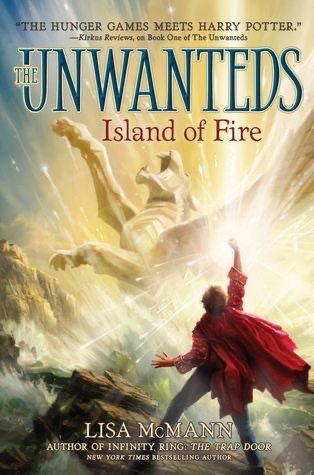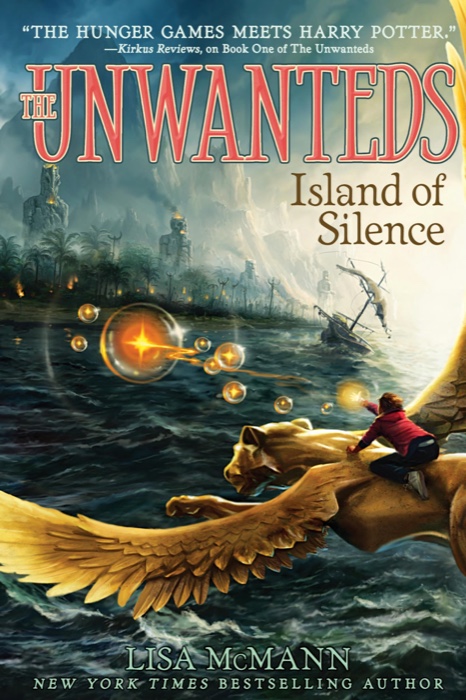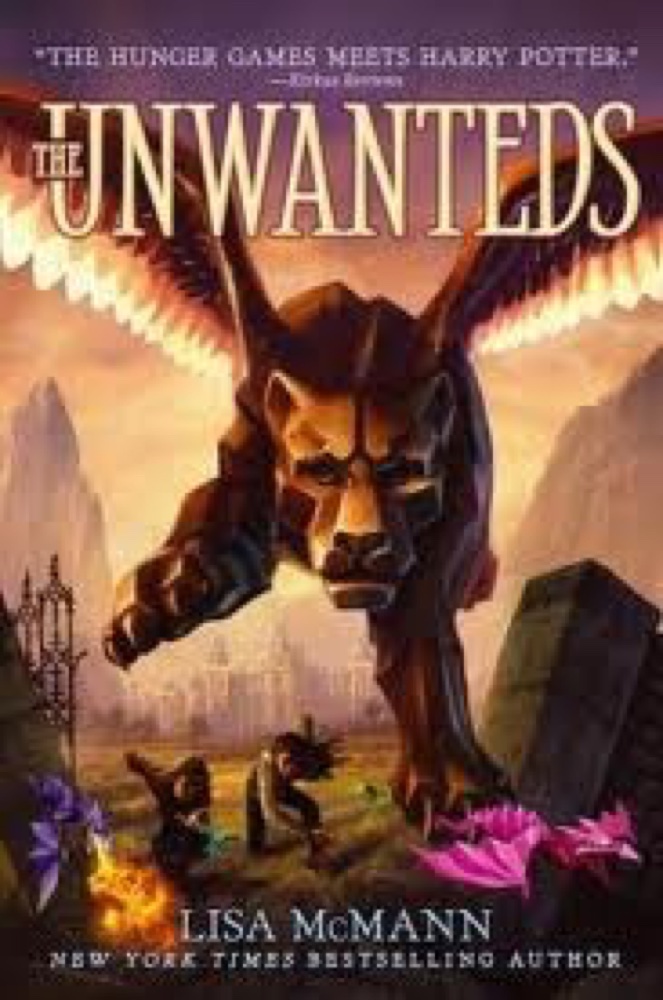

Quotes from The Unwanteds

Lisa McMann ·  390 pages

Rating: (20.5K votes)


“If you believe you can read you can”
― Lisa McMann, quote from The Unwanteds


“I'd rather die fighting to keep us free to do as we wish, fighting to be free to come and go as we please, fighting so we no longer need to hide. Fighting the fear that all of you were programmed since birth to have. Fighting against Quill's bigotry, which says brains and brawn are better, or more important, than creativity.

Marcus Today”
― Lisa McMann, quote from The Unwanteds


“Alex dropped his eyes and took in a few breaths, vowing silently not to look at Samheed again until … well, ever.”
― Lisa McMann, quote from The Unwanteds


“Alex leaned over to Samheed. “If we get an hour’s worth of music lessons, I think my head might explode.” “In that case, bring on the music,” Samheed muttered. Alex”
― Lisa McMann, quote from The Unwanteds


“I hate to do it.” “It won’t hurt them.” “That’s exactly why I hate to do it,” growled”
― Lisa McMann, quote from The Unwanteds


About the author

Lisa McMann
Born place: in Holland, Michigan, The United States
See more on GoodReads

Popular quotes

“gave up on the idea of creating “socialist men and women” who would work without monetary incentives. In a famous speech he criticized “equality mongering,” and thereafter not only did different jobs get paid different wages but also a bonus system was introduced. It is instructive to understand how this worked. Typically a firm under central planning had to meet an output target set under the plan, though such plans were often renegotiated and changed. From the 1930s, workers were paid bonuses if the output levels were attained. These could be quite high—for instance, as much as 37 percent of the wage for management or senior engineers. But paying such bonuses created all sorts of disincentives to technological change. For one thing, innovation, which took resources away from current production, risked the output targets not being met and the bonuses not being paid. For another, output targets were usually based on previous production levels. This created a huge incentive never to expand output, since this only meant having to produce more in the future, since future targets would be “ratcheted up.” Underachievement was always the best way to meet targets and get the bonus. The fact that bonuses were paid monthly also kept everyone focused on the present, while innovation is about making sacrifices today in order to have more tomorrow. Even when bonuses and incentives were effective in changing behavior, they often created other problems. Central planning was just not good at replacing what the great eighteenth-century economist Adam Smith called the “invisible hand” of the market. When the plan was formulated in tons of steel sheet, the sheet was made too heavy. When it was formulated in terms of area of steel sheet, the sheet was made too thin. When the plan for chandeliers was made in tons, they were so heavy, they could hardly hang from ceilings. By the 1940s, the leaders of the Soviet Union, even if not their admirers in the West, were well aware of these perverse incentives. The Soviet leaders acted as if they were due to technical problems, which could be fixed. For example, they moved away from paying bonuses based on output targets to allowing firms to set aside portions of profits to pay bonuses. But a “profit motive” was no more encouraging to innovation than one based on output targets. The system of prices used to calculate profits was almost completely unconnected to the value of new innovations or technology. Unlike in a market economy, prices in the Soviet Union were set by the government, and thus bore little relation to value. To more specifically create incentives for innovation, the Soviet Union introduced explicit innovation bonuses in 1946. As early as 1918, the principle had been recognized that an innovator should receive monetary rewards for his innovation, but the rewards set were small and unrelated to the value of the new technology. This changed only in 1956, when it was stipulated that the bonus should be proportional to the productivity of the innovation. However, since productivity was calculated in terms of economic benefits measured using the existing system of prices, this was again not much of an incentive to innovate. One could fill many pages with examples of the perverse incentives these schemes generated. For example, because the size of the innovation bonus fund was limited by the wage bill of a firm, this immediately reduced the incentive to produce or adopt any innovation that might have economized on labor.”
― Daron Acemoğlu, quote from Why Nations Fail: The Origins of Power, Prosperity, and Poverty


“And Cody?"
"Yeah?"
"Bring your laptop too. I need help finding a top-secret compound."
I hear him laughing quietly and I can picture him rolling his eyes as he mumbles to himself,"I should have just stayed at science camp.”
― Jessica Brody, quote from Unremembered


“We’re separated, but not lost or truly apart. Do not mourn me, my love. I have not died. . . .”
― J.R. Ward, quote from The Shadows


“The brain within its groove
Runs evenly and true;
But let a splinter swerve,
’T were easier for you
To put the water back
When floods have slit the hills,
And scooped a turnpike for themselves,
And blotted out the mills!”
― Emily Dickinson, quote from The Collected Poems of Emily Dickinson


“I had only myself to rely on. And that, I thought, was the most frightening aspect of my predicament. After all, how could I rely on someone I couldn’t trust?”
― Bella Forrest, quote from A Shade of Vampire


Interesting books

Broken
(4.9K)
Broken
by J.L. Drake
There but for the
(6.2K)
There but for the
by Ali Smith
Freaks I've Met
(1.5K)
Freaks I've Met
by Donald Jans
Love Does: Discover a Secretly Incredible Life in an Ordinary World
(31.4K)
Love Does: Discover...
by Bob Goff
Heretics
(2.9K)
Heretics
by G.K. Chesterton
We Were Three
(20)

About BookQuoters

BookQuoters is a community of passionate readers who enjoy sharing the most meaningful, memorable and interesting quotes from great books. As the world communicates more and more via texts, memes and sound bytes, short but profound quotes from books have become more relevant and important. For some of us a quote becomes a mantra, a goal or a philosophy by which we live. For all of us, quotes are a great way to remember a book and to carry with us the author’s best ideas.

We thoughtfully gather quotes from our favorite books, both classic and current, and choose the ones that are most thought-provoking. Each quote represents a book that is interesting, well written and has potential to enhance the reader’s life. We also accept submissions from our visitors and will select the quotes we feel are most appealing to the BookQuoters community.

Founded in 2023, BookQuoters has quickly become a large and vibrant community of people who share an affinity for books. Books are seen by some as a throwback to a previous world; conversely, gleaning the main ideas of a book via a quote or a quick summary is typical of the Information Age but is a habit disdained by some diehard readers. We feel that we have the best of both worlds at BookQuoters; we read books cover-to-cover but offer you some of the highlights. We hope you’ll join us.