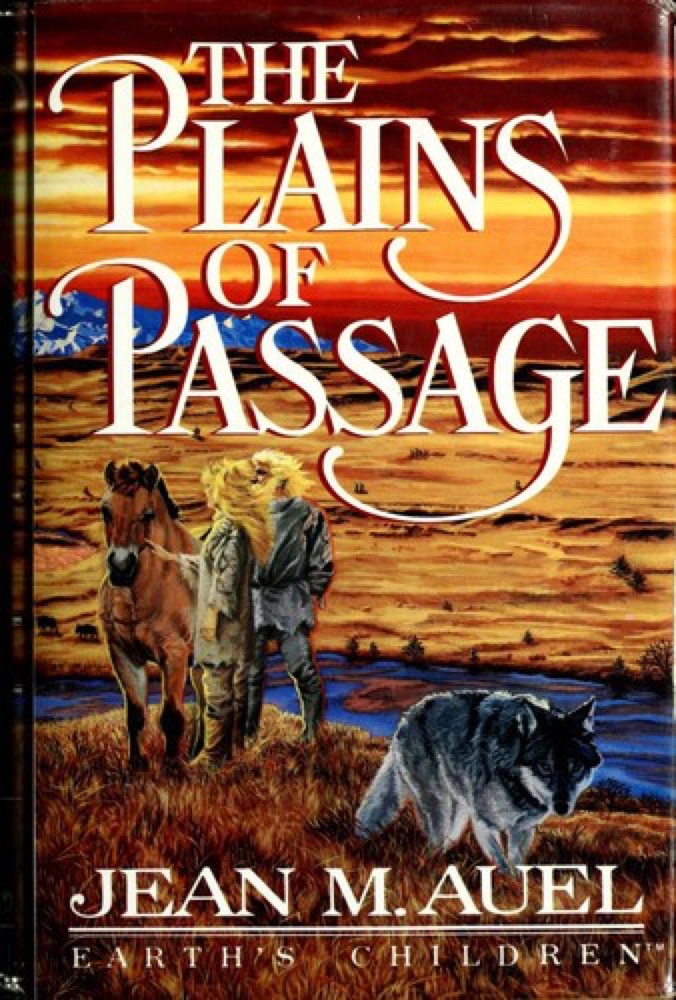

Quotes from The Plains of Passage

Jean M. Auel ·  784 pages

Rating: (44K votes)


“In a world so empty of human life, there was comfort in the thought that an invisible realm of spirits was aware of their existence, cared about their actions, and perhaps directed their steps. Even a stern or inimical spirit who cared enough to demand certain actions of appeasement was better than the heartless disregard of a harsh and indifferent world, in which their lives were entirely in their own hands, with no one else to turn to in time of need, not even in their thoughts.”
― Jean M. Auel, quote from The Plains of Passage


“When all was over, they buried the dead ancestor under piles of dirt, grass, leaves, or snow. Mammoths were even known to bury other dead animals, including humans.”
― Jean M. Auel, quote from The Plains of Passage


“But why should they blame her? They should blame the men who won’t let her alone,”
― Jean M. Auel, quote from The Plains of Passage


“Roe Deer, when your spirit returns to the Great Earth Mother, thank Her for giving us one of your kind, that we may eat,” Jondalar said quietly.”
― Jean M. Auel, quote from The Plains of Passage


About the author

Jean M. Auel
Born place: in Chicago, Illinois, The United States
Born date February 18, 1936
See more on GoodReads

Popular quotes

“The Sun King had dinner each night alone. He chose from forty dishes, served on gold and silver plate. It took a staggering 498 people to prepare each meal. He was rich because he consumed the work of other people, mainly in the form of their services. He was rich because other people did things for him. At that time, the average French family would have prepared and consumed its own meals as well as paid tax to support his servants in the palace. So it is not hard to conclude that Louis XIV was rich because others were poor.

But what about today? Consider that you are an average person, say a woman of 35, living in, for the sake of argument, Paris and earning the median wage, with a working husband and two children. You are far from poor, but in relative terms, you are immeasurably poorer than Louis was. Where he was the richest of the rich in the world’s richest city, you have no servants, no palace, no carriage, no kingdom. As you toil home from work on the crowded Metro, stopping at the shop on the way to buy a ready meal for four, you might be thinking that Louis XIV’s dining arrangements were way beyond your reach. And yet consider this. The cornucopia that greets you as you enter the supermarket dwarfs anything that Louis XIV ever experienced (and it is probably less likely to contain salmonella). You can buy a fresh, frozen, tinned, smoked or pre-prepared meal made with beef, chicken, pork, lamb, fish, prawns, scallops, eggs, potatoes, beans, carrots, cabbage, aubergine, kumquats, celeriac, okra, seven kinds of lettuce, cooked in olive, walnut, sunflower or peanut oil and flavoured with cilantro, turmeric, basil or rosemary … You may have no chefs, but you can decide on a whim to choose between scores of nearby bistros, or Italian, Chinese, Japanese or Indian restaurants, in each of which a team of skilled chefs is waiting to serve your family at less than an hour’s notice. Think of this: never before this generation has the average person been able to afford to have somebody else prepare his meals.

You employ no tailor, but you can browse the internet and instantly order from an almost infinite range of excellent, affordable clothes of cotton, silk, linen, wool and nylon made up for you in factories all over Asia. You have no carriage, but you can buy a ticket which will summon the services of a skilled pilot of a budget airline to fly you to one of hundreds of destinations that Louis never dreamed of seeing. You have no woodcutters to bring you logs for the fire, but the operators of gas rigs in Russia are clamouring to bring you clean central heating. You have no wick-trimming footman, but your light switch gives you the instant and brilliant produce of hardworking people at a grid of distant nuclear power stations. You have no runner to send messages, but even now a repairman is climbing a mobile-phone mast somewhere in the world to make sure it is working properly just in case you need to call that cell. You have no private apothecary, but your local pharmacy supplies you with the handiwork of many thousands of chemists, engineers and logistics experts. You have no government ministers, but diligent reporters are even now standing ready to tell you about a film star’s divorce if you will only switch to their channel or log on to their blogs.

My point is that you have far, far more than 498 servants at your immediate beck and call. Of course, unlike the Sun King’s servants, these people work for many other people too, but from your perspective what is the difference? That is the magic that exchange and specialisation have wrought for the human species.”
― Matt Ridley, quote from The Rational Optimist: How Prosperity Evolves


“Love thy neighbor as thyself . . . as long as he’s a Christian. Otherwise, go ahead and kill him. You’ll be doing us both a favor, believe me.” I”
― David Wilcock, quote from The Source Field Investigations: The Hidden Science and Lost Civilizations Behind the 2012 Prophecies


“I wanted to leave my decision-making behind, along with my responsibility for all future ones.”
― Hugh Howey, quote from Half Way Home


“For all these years, you’ve lived under the illusion that, somehow, you made it because you were tough enough to overpower the abuse, the hatred, the hard knocks of life. But really you made it because love is so powerful that tiny little doses of it are enough to overcome the pain of the worst things life can dish out. Toughness was a faulty coping mechanism you devised to get by. But, in reality, it has been your ability to never give up, to keep seeking love, and your resourcefulness to make that love last long enough to sustain you. That’s what has gotten you by”
― quote from Get Me Out of Here: My Recovery from Borderline Personality Disorder


“You might be offered oatcakes as well as bread (especially in the north). If these do not tempt you, consider eating "horse-bread." This is made from a sort of flour of ground peas, bran, and beans–if contemporaries look at you strangely, it is because it is not meant for human consumption.”
― Ian Mortimer, quote from The Time Traveller's Guide to Medieval England: A Handbook for Visitors to the Fourteenth Century


Interesting books

Dom Wars: Round One
(2.7K)
Dom Wars: Round One
by Lucian Bane
The Sacrifice
(4.7K)
The Sacrifice
by Charlie Higson
The Painted Man
(85.8K)
The Painted Man
by Peter V. Brett
Creativity, Inc.: Overcoming the Unseen Forces That Stand in the Way of True Inspiration
(36.9K)
Creativity, Inc.: Ov...
by Ed Catmull
Voyage on the Great Titanic: The Diary of Margaret Ann Brady, R.M.S. Titanic, 1912
(7.8K)
Voyage on the Great...
by Ellen Emerson White
The Earth Dwellers
(0.9K)
The Earth Dwellers
by David Estes

About BookQuoters

BookQuoters is a community of passionate readers who enjoy sharing the most meaningful, memorable and interesting quotes from great books. As the world communicates more and more via texts, memes and sound bytes, short but profound quotes from books have become more relevant and important. For some of us a quote becomes a mantra, a goal or a philosophy by which we live. For all of us, quotes are a great way to remember a book and to carry with us the author’s best ideas.

We thoughtfully gather quotes from our favorite books, both classic and current, and choose the ones that are most thought-provoking. Each quote represents a book that is interesting, well written and has potential to enhance the reader’s life. We also accept submissions from our visitors and will select the quotes we feel are most appealing to the BookQuoters community.

Founded in 2023, BookQuoters has quickly become a large and vibrant community of people who share an affinity for books. Books are seen by some as a throwback to a previous world; conversely, gleaning the main ideas of a book via a quote or a quick summary is typical of the Information Age but is a habit disdained by some diehard readers. We feel that we have the best of both worlds at BookQuoters; we read books cover-to-cover but offer you some of the highlights. We hope you’ll join us.