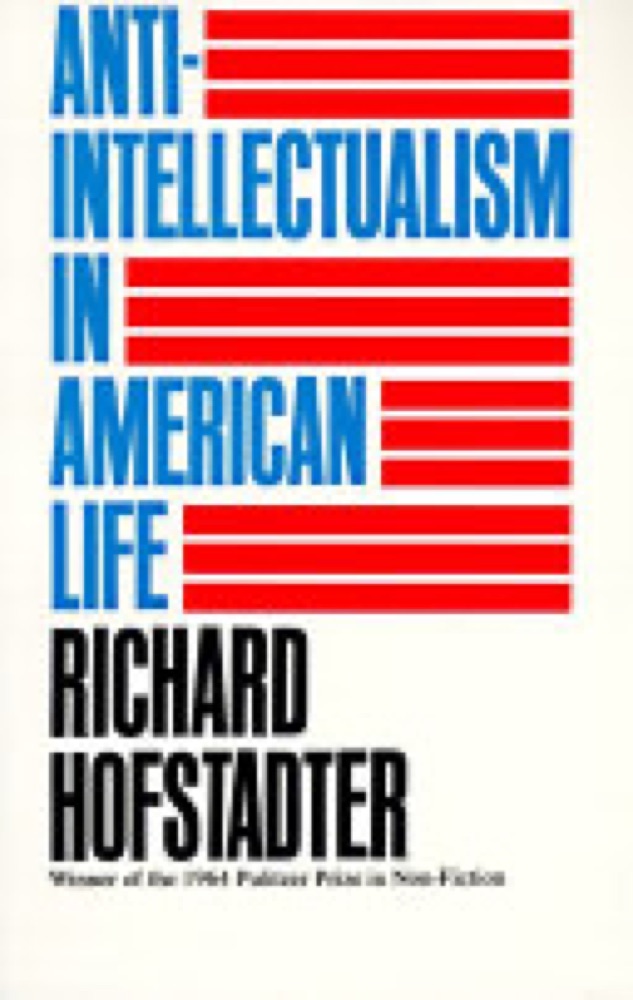
 Anti-Intellectualism in American Life
Quotes from the Book
It is a poor head that cannot find plausible reason for doing what the heart wants to do.
Get action, do things; be sane,” he once raved, “don’t fritter away your time; create, act, take a place wherever you are and be somebody: get action.
They thought man was a creature of rapacious self-interest, and yet they wanted him to be free- free, in essence, to contend, to engage in an umpired strife, to use property to get property.
[Herbert] Hoover, had he been challenged with the overpowering implausibility of his notion that economic life is a race that is won by the ablest runner, would have had a ready answer from his own biography: had he not started in life as a poor orphan and worked in the mines for a pittance, and had he not become first a millionaire and then President of the United States? There are times when nothing is more misleading than personal experience, and the man whose experience has embraced only success is likely to be a forlorn and alien figure when his whole world begins to fail.
[Grover} Cleveland, this product of good conscience and self-help, with his stern ideas of purity, efficiency, and service, was a taxpayer's dream, the ideal bourgeois statesmen for his time: out of heartfelt conviction he gave to the interests what many a lesser politician might have sold them for a price. He was the flower of American political culture in the Gilded Age.
[John C.] Calhoun was a minority spokesman in a democracy, a particularist in an age of nationalism, a slaveholder in an age of advancing liberties, and an agrarian in a furiously capitalistic country. His weakness was to be inhumanly schematic and logical, which is only to say that he thought as he lived. His mind, in a sense, was too masterful - it imposed itself upon realities. The great human, emotional, moral complexities of the world escaped him because he had no private training for them, had not even the talent for friendship, in which he might have been schooled. It was easier for him to imagine, for example, that the South had produced upon its slave base a better culture than the North because he had no culture himself, only a quick and muscular mode of thought. It may stand as a token of Calhoun's place in the South's history that when he did find culture there, at Charleston, he wished a plague upon it.
Watch on YouTube
About Richard Hofstadter
We have collected 33 quotes from 2 books by Richard Hofstadter on BookQuoters.
More about the author →More by Richard Hofstadter
Anti-Intellectualism in American Life
Book details
- Author
- Richard Hofstadter
- Genre
- History
- Goodreads rating
- 4.04 (2k ratings) →
Keep reading
 Founding Brothers: The Revolutionary Generation
 The Rise of Theodore Roosevelt
 Civil Disobedience
 Reflections on the Revolution in France
 Democracy in America
 American Lion: Andrew Jackson in the White House
 Politics
 The Invisible Bridge: The Fall of Nixon and the Rise of Reagan
 The Machiavellians: Defenders of Freedom
 De la Démocratie en Amérique, tome II
 The Path to Power
 American Colossus: The Triumph of Capitalism, 1865-1900
 The March of Folly: From Troy to Vietnam
 Civil Disobedience and Other Essays
 Benjamin Franklin: An American Life
 The Autobiography of Eleanor Roosevelt
 The Iron Heel
 Burr
Burr
 The Education of Henry Adams
 Alexander Hamilton
 Destiny of the Republic: A Tale of Madness, Medicine and the Murder of a President
 The Proud Tower: A Portrait of the World Before the War, 1890-1914
 A Connecticut Yankee in King Arthur's Court
 It Can't Happen Here
 The Nicomachean Ethics
 On Liberty
 Human Action: A Treatise on Economics
 Utopia
 The Audacity of Hope: Thoughts on Reclaiming the American Dream
 The Bully Pulpit: Theodore Roosevelt, William Howard Taft, and the Golden Age of Journalism
 Rights of Man
Anti-Intellectualism in American Life
Rights of Man
Anti-Intellectualism in American Life
 Discourse on the Origin of Inequality
 Promises to Keep: On Life and Politics
 The Autobiography of Benjamin Franklin
 Mornings on Horseback
 The First Tycoon: The Epic Life of Cornelius Vanderbilt
 Becoming Madam Secretary
 The Man Without Qualities
 Walden Two
 You Can't Be Neutral on a Moving Train: A Personal History of Our Times
 The Secret Agent
 Rules for Radicals: A Pragmatic Primer for Realistic Radicals
 Team of Rivals: The Political Genius of Abraham Lincoln
 Life Without Principle
 Liberalism: The Classical Tradition
 Common Sense
 The Soul of Man Under Socialism
 What's Wrong with the World
 Imperium: A Novel of Ancient Rome
 Truman
 God Emperor of Dune
 The Reivers
 Babbitt
 The American Spirit: Who We Are and What We Stand For
 The Republic
 Foundation and Empire
 Profiles in Courage
 Erewhon
 Warlock