Quotes from Fortunata and Jacinta

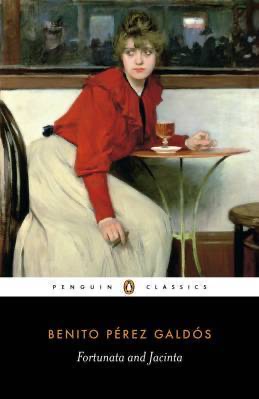
Benito Pérez Galdós ·  818 pages

Rating: (893 votes)


“más sabe el que vive sin querer saber que el que quiere saber sin vivir,”
― Benito Pérez Galdós, quote from Fortunata and Jacinta


“La moral política es como una capa con tantos remiendos, que no se sabe ya cuál es el paño primitivo.”
― Benito Pérez Galdós, quote from Fortunata and Jacinta


“apático y de la timidez que era el resultado”
― Benito Pérez Galdós, quote from Fortunata and Jacinta


“Su dentadura había salido con tanta desigualdad que cada pieza estaba, como si dijéramos, donde le daba la gana. Y”
― Benito Pérez Galdós, quote from Fortunata and Jacinta


“Vivir es relacionarse, gozar y padecer, desear, aborrecer y amar. La lectura es vida artificial y prestada, el usufructo, mediante una función cerebral, de las ideas y sensaciones ajenas, la adquisición de los tesoros de la verdad humana por compra o por estafa, no por el trabajo. No”
― Benito Pérez Galdós, quote from Fortunata and Jacinta


About the author

Benito Pérez Galdós
Born place: in Las Palmas de Gran Canaria, Canary Islands, Spain
Born date May 10, 1843
See more on GoodReads

Popular quotes

“...he asked, "Where are you today, right now?"
Eagerly, I started talking about myself. However, I noticed that I was still being sidetracked from getting answers to my questions. Still, I told him about my distant and recent past and about my inexplicable depressions. He listened patiently and intently, as if he had all the time in the world, until I finished several hours later.
"Very well," he said. "But you still have not answered my question about where you are."
"Yes I did, remember? I told you how I got to where I am today: by hard work."
"Where are you?"
"What do you mean, where am I?"
"Where Are you?" he repeated softly.
"I'm here."
"Where is here?"
"In this office, in this gas station!" I was getting impatient with this game.
"Where is this gas station?"
"In Berkeley?"
"Where is Berkeley?"
"In California?"
"Where is California?"
"In the United States?"
"On a landmass, one of the continents in the Western Hemisphere. Socrates, I..."
"Where are the continents?
I sighed. "On the earth. Are we done yet?"
"Where is the earth?"
"In the solar system, third planet from the sun. The sun is a small star in the Milky Way galaxy, all right?"
"Where is the Milky Way?"
"Oh, brother, " I sighed impatiently, rolling my eyes. "In the universe." I sat back and crossed my arms with finality.
"And where," Socrates smiled, "is the universe?"
"The universe is well, there are theories about how it's shaped..."
"That's not what I asked. Where is it?"
"I don't know - how can I answer that?"
"That is the point. You cannot answer it, and you never will. There is no knowing about it. You are ignorant of where the universe is, and thus, where you are. In fact, you have no knowledge of where anything is or of What anything is or how is came to be. Life is a mystery.
"My ignorance is based on this understanding. Your understanding is based on ignorance. This is why I am a humorous fool, and you are a serious jackass.”
― Dan Millman, quote from Way of the Peaceful Warrior: A Book That Changes Lives


“I've learned that if you wait long enough, you might get a second chance at something you gave up on. And sometimes you'll be the one to give the second chance to someone else.”
― Wendy Mass, quote from 13 Gifts


“persons who go through a great deal of trouble or pain to attain something tend to value it more highly than persons who attain the same thing with a minimum of effort.”
― Robert B. Cialdini, quote from Influence: The Psychology of Persuasion


“Night.Owl: So what are you wearing?
Little.Bird: Lol! All the walls are coming down tonight...
Night.Owl: Haha. God, sorry. I have no idea why I just typed that. Ignore that. Such a creeper right now.”
― M. Pierce, quote from Night Owl


“«Ahora me doy cuenta de que el verdadero encanto de la vida intelectual —la vida consagrada a la erudición, a las investigaciones científicas, a la filosofía, a la estética, a la crítica— es su facilidad. Es la sustitución de las complejidades de la realidad por simples esquemas intelectuales, o de los desconcertantes movimientos de la vida por la muerte formal y tranquila. Es incomparablemente más fácil saber muchas cosas, por ejemplo, acerca de la historia del arte y tener ideas profundas acerca de la metafísica y de la sociología, que saber intuitiva y personalmente algo acerca de nuestros semejantes, y llevar relaciones satisfactorias con nuestros amigos y nuestras amantes, nuestra mujer y nuestros hijos. Vivir es mucho más difícil que el sánscrito, la química o la economía política. La vida intelectual es un juego de niños; lo cual explica el que los intelectuales tiendan a convertirse en niños, y luego en imbéciles, y finalmente, como claramente de muestra la historia política e industrial de los últimos siglos, en lunáticos homicidas y bestias salvajes. Las funciones reprimidas no mueren; se deterioran, degeneran, retrogradan al estado primitivo. Pero, entretanto, es mucho más fácil ser un niño intelectual, o un lunático, o una bestia, que un hombre adulto y armonioso. He ahí por qué, entre otras razones, existe tanta demanda de educación superior. Las gentes se abalanzan hacia los libros y las universidades como hacia los cafés. Quieren ahogar su conciencia de las dificultades que presenta el vivir adecuadamente en este grotesco mundo contemporáneo: quieren olvidar su deplorable insuficiencia en el arte de la vida. Algunos ahogan sus penas en alcohol, mientras que otros, todavía más numerosos, las ahogan en los libros y en el diletantismo artístico; algunos tratan de olvidarse a sí mismos por medio de la fornicación, el baile, el cinematógrafo, la radiotelefonía; otros, por medio de conferencias y ocupaciones científicas. Los libros y las conferencias son mejores para ahogar las penas que la bebida y la fornicación: no dejan dolor de cabeza, ni aquella desesperante sensación del post coitum triste.»”
― Aldous Huxley, quote from Point Counter Point


Interesting books

Kitchen Confidential: Adventures in the Culinary Underbelly
(154K)
Kitchen Confidential...
by Anthony Bourdain
The Last Continent
(40.5K)
The Last Continent
by Terry Pratchett
The Prince
(58.5K)
The Prince
by Kiera Cass
Pedagogy of the Oppressed
(19.2K)
Pedagogy of the Oppr...
by Paulo Freire
Killing Yourself to Live: 85% of a True Story
(24.5K)
Killing Yourself to...
by Chuck Klosterman
The Woods
(53.9K)
The Woods
by Harlan Coben

About BookQuoters

BookQuoters is a community of passionate readers who enjoy sharing the most meaningful, memorable and interesting quotes from great books. As the world communicates more and more via texts, memes and sound bytes, short but profound quotes from books have become more relevant and important. For some of us a quote becomes a mantra, a goal or a philosophy by which we live. For all of us, quotes are a great way to remember a book and to carry with us the author’s best ideas.

We thoughtfully gather quotes from our favorite books, both classic and current, and choose the ones that are most thought-provoking. Each quote represents a book that is interesting, well written and has potential to enhance the reader’s life. We also accept submissions from our visitors and will select the quotes we feel are most appealing to the BookQuoters community.

Founded in 2023, BookQuoters has quickly become a large and vibrant community of people who share an affinity for books. Books are seen by some as a throwback to a previous world; conversely, gleaning the main ideas of a book via a quote or a quick summary is typical of the Information Age but is a habit disdained by some diehard readers. We feel that we have the best of both worlds at BookQuoters; we read books cover-to-cover but offer you some of the highlights. We hope you’ll join us.