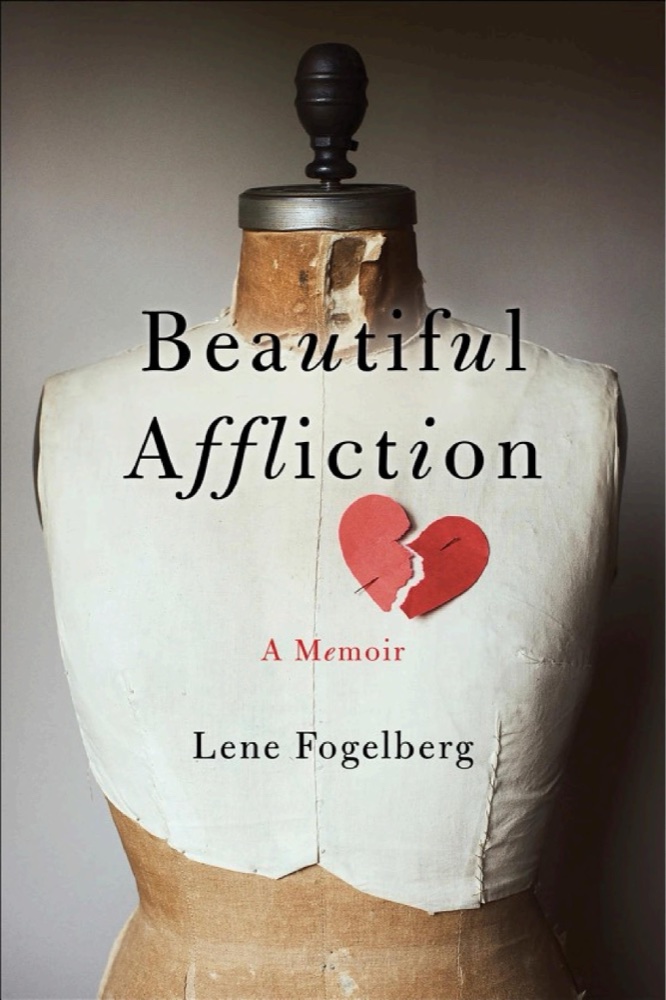

Quotes from Beautiful Affliction

Lene Fogelberg ·  352 pages

Rating: (523 votes)


“Dancing is like poetry written by our bodies: our outstretched arms our words of longing.”
― Lene Fogelberg, quote from Beautiful Affliction


“In strength the body only knows itself, is full of itself, its movements, its words, but in weakness is the invisible and the whisperings.”
― Lene Fogelberg, quote from Beautiful Affliction


“She is one of these women who always carries a home with her, wherever she is.”
― Lene Fogelberg, quote from Beautiful Affliction


“He laughs again and I want to eat his laughter, be nourished by it, feel it in my blood.”
― Lene Fogelberg, quote from Beautiful Affliction


“Maybe there is an invisible world working behind our own, maybe words in the silence, maybe movements in what looks completely still. When every door is closed, maybe doors are opening that can’t be seen.”
― Lene Fogelberg, quote from Beautiful Affliction


“Sometimes you know that you are destined to die, but somehow you are given a parenthesis after the punctuation mark: more years, more time that wasn’t meant for you but still was meant for you, a bridge stretching out into the stars, a confidence built of invisible threads, a miracle.”
― Lene Fogelberg, quote from Beautiful Affliction


About the author

Lene Fogelberg
Born place: in Gothenburg, Sweden
See more on GoodReads

Popular quotes

“But whatever dismal appearance of things there may be in the world, we need not fear the ruin of the church by the most bloody oppositions. Former experiences will give security against future events. It is built on the rock, and those gates of hell shall not prevail against it.”
― John Owen, quote from The Glory of Christ


“Do you know what the Sharkgard call humans on a ship?> ”
― Anne Bishop, quote from Marked in Flesh


[A Chinese Restaurant.] Roma is seated alone at the booth.Lingk is at the booth next to him.Roma is talking to him.
* * *

Roma: . . . Eh? What I’m saying, what is our life? (Pause.) It’s looking forward or it’s looking back. And that’s our life. That’s it. Where is the moment? (Pause.) And what is it that we’re afraid of? Loss. What else? (Pause.) The bank closes. We get sick, my wife died on a plane, the stock market collapsed . . . the house burnt down . . . what of these happen . . . ? None of ’em. We worry anyway. What does this mean? I’m not secure. How can I be secure? (Pause.) Through amassing wealth beyond all measure? No. And what’s beyond all measure? That’s a sickness. That’s a trap. There is no measure. Only greed. How can we act? The right way, we would say, to deal with this: “There is a one-in-a million chance that so and so will happen. . . . Fuck it, it won’t happen to me. . . .” No. We know that’s not the right way I think. (Pause.) We say the correct way to deal with this is “There is a one-in-so-and-so chance that this will happen . . . God protect me. I am powerless, let it not happen to me. . . .” But no to that. I say. There’s something else. What is it? “If it happens, AS IT MAY for that is not within our powers, I will deal with it, just as I do today with what draws my concern today.” I say this is how we must act. I do those things which seem correct to me today. I trust myself. And if security concerns me, I do that which today I think will make me secure. And every day I do that, when that day arrives that I need a reserve, (a) odds are that I have it, and (b) the true reserve that I have is the strength that I have of acting each day without fear. (Pause.) According to the dictates of my mind. (Pause.)
― David Mamet, quote from Glengarry Glen Ross


“غيري يكتب كما يتكلم ، و أنا أكتب كما ألتزم الصمت”
― Amin Maalouf, quote from Balthasar's Odyssey


Marginalia

Sometimes the notes are ferocious,
skirmishes against the author
raging along the borders of every page
in tiny black script.
If I could just get my hands on you,
Kierkegaard, or Conor Cruise O'Brien,
they seem to say,
I would bolt the door and beat some logic into your head.

Other comments are more offhand, dismissive -
Nonsense." "Please!" "HA!!" -
that kind of thing.
I remember once looking up from my reading,
my thumb as a bookmark,
trying to imagine what the person must look like
who wrote "Don't be a ninny"
alongside a paragraph in The Life of Emily Dickinson.

Students are more modest
needing to leave only their splayed footprints
along the shore of the page.
One scrawls "Metaphor" next to a stanza of Eliot's.
Another notes the presence of "Irony"
fifty times outside the paragraphs of A Modest Proposal.

Or they are fans who cheer from the empty bleachers,
Hands cupped around their mouths.
Absolutely," they shout
to Duns Scotus and James Baldwin.
Yes." "Bull's-eye." "My man!"
Check marks, asterisks, and exclamation points
rain down along the sidelines.

And if you have managed to graduate from college
without ever having written "Man vs. Nature"
in a margin, perhaps now
is the time to take one step forward.

We have all seized the white perimeter as our own
and reached for a pen if only to show
we did not just laze in an armchair turning pages;
we pressed a thought into the wayside,
planted an impression along the verge.

Even Irish monks in their cold scriptoria
jotted along the borders of the Gospels
brief asides about the pains of copying,
a bird singing near their window,
or the sunlight that illuminated their page-
anonymous men catching a ride into the future
on a vessel more lasting than themselves.

And you have not read Joshua Reynolds,
they say, until you have read him
enwreathed with Blake's furious scribbling.

Yet the one I think of most often,
the one that dangles from me like a locket,
was written in the copy of Catcher in the Rye
I borrowed from the local library
one slow, hot summer.
I was just beginning high school then,
reading books on a davenport in my parents' living room,
and I cannot tell you
how vastly my loneliness was deepened,
how poignant and amplified the world before me seemed,
when I found on one page

A few greasy looking smears
and next to them, written in soft pencil-
by a beautiful girl, I could tell,
whom I would never meet-
Pardon the egg salad stains, but I'm in love.”
― Billy Collins, quote from Picnic, Lightning


Interesting books

The Philosopher and the Wolf: Lessons from the Wild on Love, Death, and Happiness
(1.8K)
The Philosopher and...
by Mark Rowlands
The Passenger
(20.4K)
The Passenger
by Lisa Lutz
Dead by Morning
(170)
Dead by Morning
by Kayla Krantz
Disclaimer
(18.6K)
Disclaimer
by Renée Knight
Anthology Complex
(526)
Corazón de tinta
(312.2K)
Corazón de tinta
by Cornelia Funke

About BookQuoters

BookQuoters is a community of passionate readers who enjoy sharing the most meaningful, memorable and interesting quotes from great books. As the world communicates more and more via texts, memes and sound bytes, short but profound quotes from books have become more relevant and important. For some of us a quote becomes a mantra, a goal or a philosophy by which we live. For all of us, quotes are a great way to remember a book and to carry with us the author’s best ideas.

We thoughtfully gather quotes from our favorite books, both classic and current, and choose the ones that are most thought-provoking. Each quote represents a book that is interesting, well written and has potential to enhance the reader’s life. We also accept submissions from our visitors and will select the quotes we feel are most appealing to the BookQuoters community.

Founded in 2023, BookQuoters has quickly become a large and vibrant community of people who share an affinity for books. Books are seen by some as a throwback to a previous world; conversely, gleaning the main ideas of a book via a quote or a quick summary is typical of the Information Age but is a habit disdained by some diehard readers. We feel that we have the best of both worlds at BookQuoters; we read books cover-to-cover but offer you some of the highlights. We hope you’ll join us.