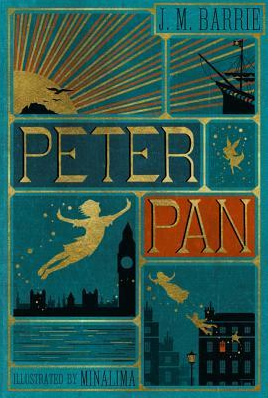
J.M. Barrie · 256 pages
Rating: (213K votes)
“To die will be an awfully big adventure.”
― J.M. Barrie, quote from Peter Pan (Illustrated with Interactive Elements)
“All the world is made of faith, and trust, and pixie dust.”
― J.M. Barrie, quote from Peter Pan (Illustrated with Interactive Elements)
“Never say goodbye because goodbye means going away and going away means forgetting.”
― J.M. Barrie, quote from Peter Pan (Illustrated with Interactive Elements)
“The moment you doubt whether you can fly, you cease for ever to be able to do it.”
― J.M. Barrie, quote from Peter Pan (Illustrated with Interactive Elements)
“Dreams do come true, if only we wish hard enough. You can have anything in life if you will sacrifice everything else for it.”
― J.M. Barrie, quote from Peter Pan (Illustrated with Interactive Elements)

“When the first baby laughed for the first time, its laugh broke into a thousand pieces, and they all went skipping about, and that was the beginning of fairies.”
― J.M. Barrie, quote from Peter Pan (Illustrated with Interactive Elements)
“Second star to the right and straight on 'til morning. ”
― J.M. Barrie, quote from Peter Pan (Illustrated with Interactive Elements)
“To live will be an awfully big adventure.”
― J.M. Barrie, quote from Peter Pan (Illustrated with Interactive Elements)
“Wendy," Peter Pan continued in a voice that no woman has ever yet been able to resist, "Wendy, one girl is more use than twenty boys.”
― J.M. Barrie, quote from Peter Pan (Illustrated with Interactive Elements)
“Never is an awfully long time.”
― J.M. Barrie, quote from Peter Pan (Illustrated with Interactive Elements)
“All children, except one, grow up.”
― J.M. Barrie, quote from Peter Pan (Illustrated with Interactive Elements)
“Stars are beautiful, but they may not take part in anything, they must just look on forever.”
― J.M. Barrie, quote from Peter Pan (Illustrated with Interactive Elements)
“Build a house?" exclaimed John.
"For the Wendy," said Curly.
"For Wendy?" John said, aghast. "Why, she is only a girl!"
"That," explained Curly, "is why we are her servants.”
― J.M. Barrie, quote from Peter Pan (Illustrated with Interactive Elements)
“Fairies have to be one thing or the other, because being so small they unfortunately have room for one feeling only at a time.”
― J.M. Barrie, quote from Peter Pan (Illustrated with Interactive Elements)
“You need not be sorry for her. She was one of the kind that likes to grow up. In the end she grew up of her own free will a day quicker than the other girls.”
― J.M. Barrie, quote from Peter Pan (Illustrated with Interactive Elements)
“You know that place between sleep and awake, that place where you still remember dreaming? That’s where I’ll always love you. That’s where I’ll be waiting.”
― J.M. Barrie, quote from Peter Pan (Illustrated with Interactive Elements)
“There could not have been a lovelier sight; but there was none to see it except a little boy who was staring in at the window. He had ecstasies innumerable that other children can never know; but he was looking through the window at the one joy from which he must be for ever barred.”
― J.M. Barrie, quote from Peter Pan (Illustrated with Interactive Elements)
“If you cannot teach me to fly, teach me to sing.”
― J.M. Barrie, quote from Peter Pan (Illustrated with Interactive Elements)
“All children, except one, grow up. They soon know that they will grow up, and the way Wendy knew was this. One day when she was two years old she was playing in a garden, and she plucked another flower and ran with it to her mother. I suppose she must have looked rather delightful, for Mrs Darling put her hand to her heart and cried, ‘Oh, why can’t you remain like this for ever!’ This was all that passed between them on the subject, but henceforth Wendy knew that she must grow up. You always know after you are two. Two is the beginning of the end.”
― J.M. Barrie, quote from Peter Pan (Illustrated with Interactive Elements)
“I suppose it's like the ticking crocodile, isn't it? Time is chasing after all of us.”
― J.M. Barrie, quote from Peter Pan (Illustrated with Interactive Elements)
“Pan, who and what art thou?" he cried huskily.
"I'm youth, I'm joy," Peter answered at a venture, "I'm a little bird that has broken out of the egg.”
― J.M. Barrie, quote from Peter Pan (Illustrated with Interactive Elements)
“I taught you to fight and to fly. What more could there be?”
― J.M. Barrie, quote from Peter Pan (Illustrated with Interactive Elements)
“If you shut your eyes and are a lucky one, you may see at times a shapeless pool of lovely pale colours suspended in the darkness; then if you squeeze your eyes tighter, the pool begins to take shape, and the colours become so vivid that with another squeeze they must go on fire.”
― J.M. Barrie, quote from Peter Pan (Illustrated with Interactive Elements)
“Just always be waiting for me.”
― J.M. Barrie, quote from Peter Pan (Illustrated with Interactive Elements)
“Stars are beautiful, but they may not take an active part in anything, they must just look on for ever. It is a punishment put on them for something they did so long ago that no star now knows what it was. So the older ones have become glassy-eyed and seldom speak (winking is the star language), but the little ones still wonder.”
― J.M. Barrie, quote from Peter Pan (Illustrated with Interactive Elements)
“Can anything harm us, mother, after the night-lights are lit?"
Nothing, precious," she said; "they are the eyes a mother leaves behind her to guard her children.”
― J.M. Barrie, quote from Peter Pan (Illustrated with Interactive Elements)
“She asked where he lived.
Second to the right,' said Peter, 'and then straight on till morning.”
― J.M. Barrie, quote from Peter Pan (Illustrated with Interactive Elements)
“There is a saying in the Neverland that,every time you breathe, a grown-up dies.”
― J.M. Barrie, quote from Peter Pan (Illustrated with Interactive Elements)
“She was a lovely lady, with a romantic mind and such a sweet mocking mouth. Her romantic mind was like the tiny boxes, one within the other, that come from the puzzling East, however many you discover there is always one more; and her sweet mocking mouth had one kiss on it that Wendy could never get, though there it was, perfectly conspicuous in the right-hand corner.”
― J.M. Barrie, quote from Peter Pan (Illustrated with Interactive Elements)
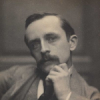
J.M. Barrie
Born place: in Kirriemuir, Angus, Scotland
Born date May 9, 1860
See more on GoodReads
“All those who are left legacies in my will…will obtain my bequests only on one condition, that they cut my body in pieces and eat it before the eyes of the citizens…You must merely shield your eyes, and imagine that what you have swallowed is not human entrails but ten million sesterces.”
― Petronius Arbiter, quote from The Satyricon
“Besides it’s as nothing to the death of a child. He doesn’t mind telling you his faith was sorely tried. There’s no grief like a parent’s.”
― Eimear McBride, quote from A Girl Is a Half-formed Thing
“your crazy makes my crazy make sense”
― Lindy Zart, quote from Roomies
“You always make me get so fuckin’ emotional. I’d get my ass beat if anyone saw me the way I am with you.”
― Riley Hart, quote from Broken Pieces
“I’ve met dozens of officers who think their immaculate mustache can move the world.”
― Brian McClellan, quote from The Autumn Republic

 Perfectly Imperfect
 A Corner of the Univ...
 Hidden Husband
 Fludd
Fludd
 The Secret Letters o...
BookQuoters is a community of passionate readers who enjoy sharing the most meaningful, memorable and interesting quotes from great books. As the world communicates more and more via texts, memes and sound bytes, short but profound quotes from books have become more relevant and important. For some of us a quote becomes a mantra, a goal or a philosophy by which we live. For all of us, quotes are a great way to remember a book and to carry with us the author’s best ideas.
We thoughtfully gather quotes from our favorite books, both classic and current, and choose the ones that are most thought-provoking. Each quote represents a book that is interesting, well written and has potential to enhance the reader’s life. We also accept submissions from our visitors and will select the quotes we feel are most appealing to the BookQuoters community.
Founded in 2023, BookQuoters has quickly become a large and vibrant community of people who share an affinity for books. Books are seen by some as a throwback to a previous world; conversely, gleaning the main ideas of a book via a quote or a quick summary is typical of the Information Age but is a habit disdained by some diehard readers. We feel that we have the best of both worlds at BookQuoters; we read books cover-to-cover but offer you some of the highlights. We hope you’ll join us.
