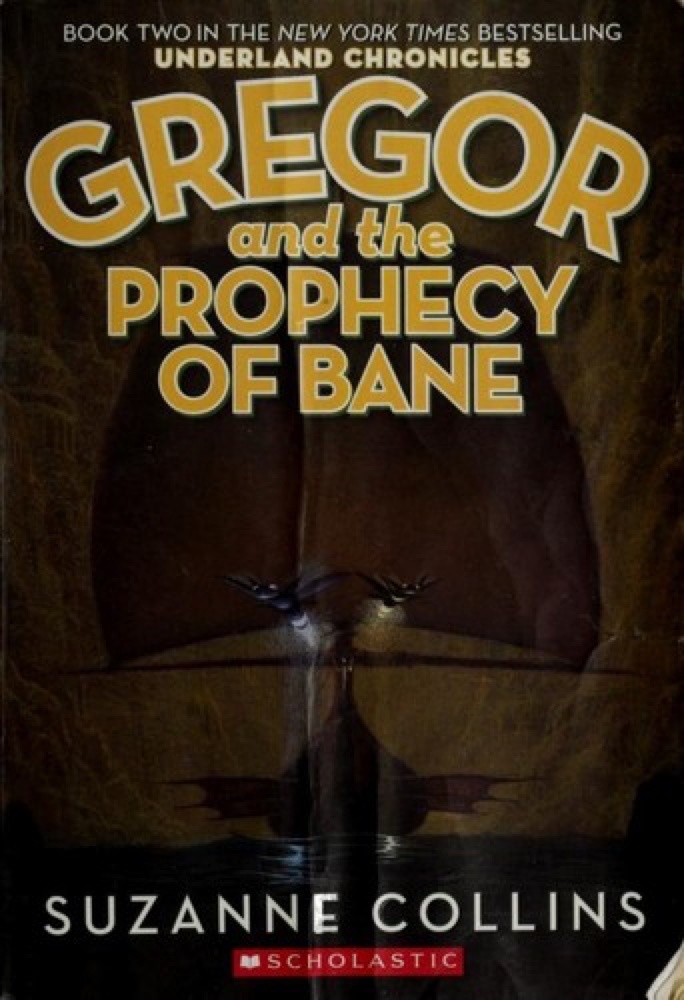


Suzanne Collins · 312 pages
Rating: (34.1K votes)
“Allow me to translate, Twitchtip said, not even bothering to move. "She said if you don't stop your incessant babble, that big rat sitting in the boat next to you will rip your head off.”
― Suzanne Collins, quote from Gregor and the Prophecy of Bane
“You come up and read books?” asked Gregor. “Read them, eat them, whatever mood strikes me,”
― Suzanne Collins, quote from Gregor and the Prophecy of Bane
“Any rats around?” asked Gregor. “Just the one on my back,” said Ares.”
― Suzanne Collins, quote from Gregor and the Prophecy of Bane
“Luxa stood up, her face paler than usual. She went to her cousin, sat beside him, and put her arms around him. Pressing her forehead into his shoulder, she said, “She will fly with you always. You know this. She will fly with you always.”
― Suzanne Collins, quote from Gregor and the Prophecy of Bane
“Everything bad was worse at the holidays, he knew that from the years of his dad’s absence. All around you were people in an extra-happy mood, and it just made your own hurt bigger.”
― Suzanne Collins, quote from Gregor and the Prophecy of Bane
“I didn't know you could feel lucky for getting to hold a girl's hair back while she pukes into the bushes. I didn't know you could look at a girl and think, 'Jesus, I could fall so hard for you if you'd let me.”
― Dahlia Adler, quote from Just Visiting
“His voice was soft as his pet name for me rolled off his gorgeous lips. And the way he looked at me… I could ask for the Hope diamond on a silver platter and I had little doubt he would figure out a way to bring it to me.”
― Meredith Wild, quote from Hard Limit
“On this particular day her father, the vicar of a parish on the sea-swept outskirts of Lower Wessex, and a widower, was suffering from an attack of gout. After finishing her household supervision Elfride became restless, and several times left the room, ascended the staircase, and knocked at her father's chamber-door.
'Come in!' was always answered in a heart out-of-door voice from the inside.
'Papa,' she said on one occasion to the fine, red-faced, handsome man of forty, who, puffing and fizzing like a bursting bottle, lay on the bed wrapped in a dressing-gown, and every now and then enunciating, in spite of himself, about one letter of some word or words that were almost oaths; 'papa, will you not come downstairs this evening?' She spoke distinctly: he was rather deaf.
'Afraid not - eh-h-h! - very much afraid I shall not, Elfride. Piph-ph-ph! I can't bear even a handkerchief upon this deuced toe of mine, much less a stocking or slipper - piph-ph-ph! There 'tis again! No, I shan't get up till tomorrow.'
'Then I hope this London man won't come; for I don't know what I should do, papa.'
'Well, it would be awkward, certainly.'
'I should hardly think he would come today.'
'Why?'
'Because the wind blows so.'
'Wind! What ideas you have, Elfride! Who ever heard of wind stopping a man from doing his business? The idea of this toe of mine coming on so suddenly!... If he should come, you must send him up to me, I suppose, and then give him some food and put him to bed in some way. Dear me, what a nuisance all this is!'
'Must he have dinner?'
'Too heavy for a tired man at the end of a tedious journey.'
'Tea, then?'
'Not substantial enough.'
'High tea, then? There is cold fowl, rabbit-pie, some pasties, and things of that kind.'
'Yes, high tea.'
'Must I pour out his tea, papa?'
'Of course; you are the mistress of the house.'
'What! sit there all the time with a stranger, just as if I knew him, and not anybody to introduce us?'
'Nonsense, child, about introducing; you know better than that. A practical professional man, tired and hungry, who has been travelling ever since daylight this morning, will hardly be inclined to talk and air courtesies tonight. He wants food and shelter, and you must see that he has it, simply because I am suddenly laid up and cannot. There is nothing so dreadful in that, I hope? You get all kinds of stuff into your head from reading so many of those novels.”
― Thomas Hardy, quote from A Pair of Blue Eyes
“Floating down the river, I could not keep my eyes off the Potala; I knew the Dalai Lama was on the roof looking at me through his telescope. On”
― Heinrich Harrer, quote from Seven Years in Tibet (Paladin Books)
“Mas don Rigoberto sabia que não havia outro remédio, tinha que se resignar e esperar. Provavelmente as únicas brigas do casal ao longo de todos os anos que estavam juntos foram causadas pelos atrasos de Lucrecia sempre que iam sair, para onde fosse, um cinema, um jantar, uma exposição, fazer compras, uma operação bancária, uma viagem. No começo, quando começaram a morar juntos, recém-casados, ele pensava que sua mulher demorava por mera inapetência e desprezo pela pontualidade. Tiveram discussões, desavenças, brigas por causa disso. Pouco a pouco, do Rigoberto, observando-a, refletindo, entendeu que esses atrasos da esposa na hora de sair para qualquer compromisso não eram uma coisa superficial, um desleixo de mulher orgulhosa. Obedeciam a algo mais profundo, um estado ontológico da alma, porque, sem que ela tivesse consciência do que lhe ocorria, toda vez que precisava sair de algum lugar, da sua própria casa, a de uma amiga que estava visitando, o restaurante onde acabara de jantar, era dominada por uma inquietação recôndita, uma insegurança, um medo obscuro, primitivo, de ter que ir embora, sair dali, mudar de lugar, e então inventava todo tipo de pretextos - pegar um lenço, trocar a bolsa, procurar as chaves, verificar se as janelas estavam bem fechadas, a televisão desligada, se o fogão não estava acesso ou o telefone fora do gancho -, qualquer coisa que atrasasse por alguns minutos ou segundos a pavorosa ação de partir.
Ela sempre foi assim? Quando era pequena também? Não se atreveu a perguntar. Mas já havia constatado que, com o passar dos anos, esse prurido, mania ou fatalidade se acentuava, a tal ponto que Rigoberto às vezes pensava, com um calafrio, que talvez chegasse o dia que Lucrecia, com a mesma benignidade do personagem de Melville, ia contrair a letargia ou indolência metafísica de Bartleby e decidir não mais sair da sua casa, quem sabe do seu quarto e até da sua cama. "Medo de abandonar o ser, de perder o ser, de ficar sem seu ser", pensou mais uma vez. Era o diagnóstico que havia chegado em relação aos atrasos da esposa.”
― Mario Vargas Llosa, quote from The Time of the Hero
BookQuoters is a community of passionate readers who enjoy sharing the most meaningful, memorable and interesting quotes from great books. As the world communicates more and more via texts, memes and sound bytes, short but profound quotes from books have become more relevant and important. For some of us a quote becomes a mantra, a goal or a philosophy by which we live. For all of us, quotes are a great way to remember a book and to carry with us the author’s best ideas.
We thoughtfully gather quotes from our favorite books, both classic and current, and choose the ones that are most thought-provoking. Each quote represents a book that is interesting, well written and has potential to enhance the reader’s life. We also accept submissions from our visitors and will select the quotes we feel are most appealing to the BookQuoters community.
Founded in 2023, BookQuoters has quickly become a large and vibrant community of people who share an affinity for books. Books are seen by some as a throwback to a previous world; conversely, gleaning the main ideas of a book via a quote or a quick summary is typical of the Information Age but is a habit disdained by some diehard readers. We feel that we have the best of both worlds at BookQuoters; we read books cover-to-cover but offer you some of the highlights. We hope you’ll join us.