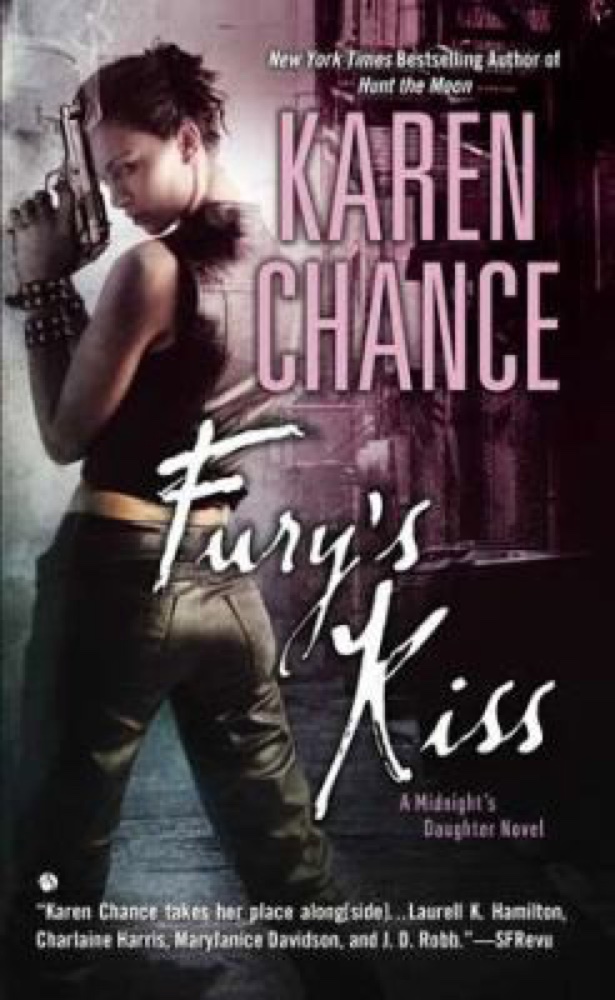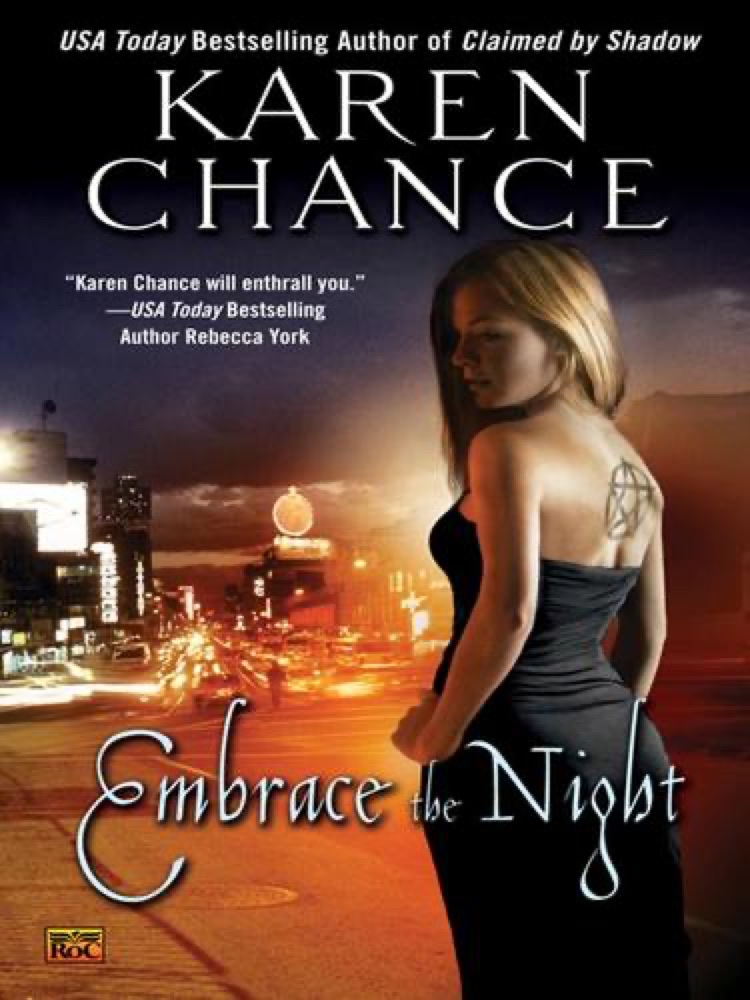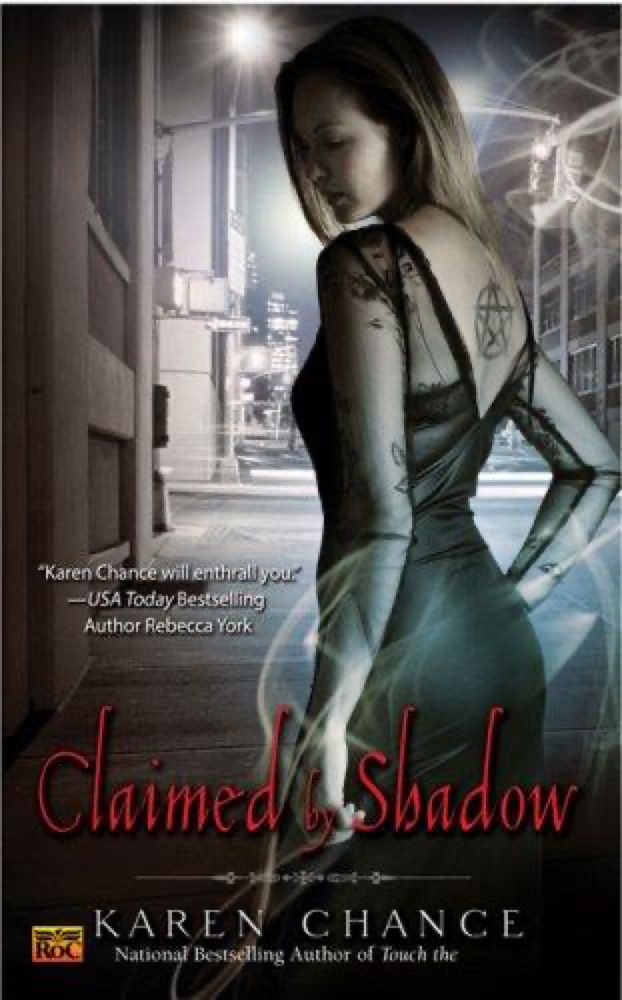

“He had the look of an atheist who’d just had a visit from God: stunned, disbelieving and faintly ill.”
― Karen Chance, quote from Claimed By Shadow
“Pritkin gave me a little shake and I eyed him without favor. The only other occasions when I had been dragged back in time, the trip had been triggered by proximity to a person whose past was being threatened.
I have to tell you,” I said frankly, “if someone is trying to mess with your conception or something, I’m not feeling a pressing need to intervene.”
― Karen Chance, quote from Claimed By Shadow
“I dodged behind Mac for cover and refused to take the bait. I glanced at my nonexistent watch. 'Oops, look at the time. Guess I have to be going now. Let's not do this again sometime, okay?'
Before I could move, Pritkin was there, jamming the medallion into the skin of my upper arm.'Ow!'He looked at me expectantly. I glared at him. 'That hurt!'
What do you see?'
A big red mark,”
― Karen Chance, quote from Claimed By Shadow
“It's about time! It's supposed to be a ritual, not a marathon.”
― Karen Chance, quote from Claimed By Shadow
“Any day that starts off in a demon-filled bar in a casino designed to look like Hell isn't likely to turn out well.”
― Karen Chance, quote from Claimed By Shadow
“Tony wanted to kill me, the Senate wanted to make me their stooge, and, oh, yeah, I'd also managed to piss off the mages. What can I say? I'm an overachiever.”
― Karen Chance, quote from Claimed By Shadow
“Hakikatleri örten bir perdedir karanlık. Onun saklı dünyasına tek tanıklık edense peşinden ayrılmayan gölgesidir.”
― Karen Chance, quote from Claimed By Shadow
“Thir must be less tae life than this”
― Irvine Welsh, quote from Trainspotting
“I have no love for a friend who loves in words alone.”
― Sophocles, quote from Antigone
“For glory lit, and life alive, for goals unreached and aims to strive. All men must try, the wind did see. It is the test, it is the dream.”
― Brandon Sanderson, quote from Words of Radiance
“ It is as true for the writer as for the reader that any novel worth its ink should be an experience first and foremost—not an essay, not a statement, not an orderly rollout of themes and propositions. All of which is to say: stories, too, are wild things. ”
― David Wroblewski, quote from The Story of Edgar Sawtelle
“I was extremely curious about the alternatives to the kind of life I had been leading, and my friends and I exchanged rumors and scraps of information we dug from official publications. I was struck less by the West's technological developments and high living standards than by the absence of political witch-hunts, the lack of consuming suspicion, the dignity of the individual, and the incredible amount of liberty. To me, the ultimate proof of freedom in the West was that there seemed to be so many people there attacking the West and praising China. Almost every other day the front page of Reference, the newspaper which carded foreign press items, would feature some eulogy of Mao and the Cultural Revolution. At first I was angered by these, but they soon made me see how tolerant another society could be. I realized that this was the kind of society I wanted to live in: where people were allowed to hold different, even outrageous views. I began to see that it was the very tolerance of oppositions, of protesters, that kept the West progressing.
Still, I could not help being irritated by some observations. Once I read an article by a Westerner who came to China to see some old friends, university professors, who told him cheerfully how they had enjoyed being denounced and sent to the back end of beyond, and how much they had relished being reformed. The author concluded that Mao had indeed made the Chinese into 'new people' who would regard what was misery to a Westerner as pleasure.
I was aghast. Did he not know that repression was at its worst when there was no complaint? A hundred times more so when the victim actually presented a smiling face? Could he not see to what a pathetic condition these professors had been reduced, and what horror must have been involved to degrade them so? I did not realize that the acting that the Chinese were putting on was something to which Westerners were unaccustomed, and which they could not always decode.
I did not appreciate either that information about China was not easily available, or was largely misunderstood, in the West, and that people with no experience of a regime like China's could take its propaganda and rhetoric at face value. As a result, I assumed that these eulogies were dishonest. My friends and I would joke that they had been bought by our government's 'hospitality." When foreigners were allowed into certain restricted places in China following Nixon's visit, wherever they went the authorities immediately cordoned off enclaves even within these enclaves. The best transport facilities, shops, restaurants, guest houses and scenic spots were reserved for them, with signs reading "For Foreign Guests Only." Mao-tai, the most sought-after liquor, was totally unavailable to ordinary Chinese, but freely available to foreigners. The best food was saved for foreigners. The newspapers proudly reported that Henry Kissinger had said his waistline had expanded as a result of the many twelve-course banquets he enjoyed during his visits to China. This was at a time when in Sichuan, "Heaven's Granary," our meat ration was half a pound per month, and the streets of Chengdu were full of homeless peasants who had fled there from famine in the north, and were living as beggars. There was great resentment among the population about how the foreigners were treated like lords. My friends and I began saying among ourselves: "Why do we attack the Kuomintang for allowing signs saying "No Chinese or Dogs" aren't we doing the same?
Getting hold of information became an obsession. I benefited enormously from my ability to read English, as although the university library had been looted during the Cultural Revolution, most of the books it had lost had been in Chinese. Its extensive English-language collection had been turned upside down, but was still largely intact.”
― Jung Chang, quote from Wild Swans: Three Daughters of China
BookQuoters is a community of passionate readers who enjoy sharing the most meaningful, memorable and interesting quotes from great books. As the world communicates more and more via texts, memes and sound bytes, short but profound quotes from books have become more relevant and important. For some of us a quote becomes a mantra, a goal or a philosophy by which we live. For all of us, quotes are a great way to remember a book and to carry with us the author’s best ideas.
We thoughtfully gather quotes from our favorite books, both classic and current, and choose the ones that are most thought-provoking. Each quote represents a book that is interesting, well written and has potential to enhance the reader’s life. We also accept submissions from our visitors and will select the quotes we feel are most appealing to the BookQuoters community.
Founded in 2023, BookQuoters has quickly become a large and vibrant community of people who share an affinity for books. Books are seen by some as a throwback to a previous world; conversely, gleaning the main ideas of a book via a quote or a quick summary is typical of the Information Age but is a habit disdained by some diehard readers. We feel that we have the best of both worlds at BookQuoters; we read books cover-to-cover but offer you some of the highlights. We hope you’ll join us.