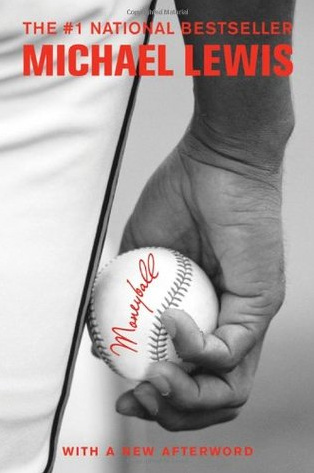
Michael Lewis · 317 pages
Rating: (75.8K votes)
“The pleasure of rooting for Goliath is that you can expect to win. The pleasure of rooting for David is that, while you don’t know what to expect, you stand at least a chance of being inspired.”
― Michael Lewis, quote from Moneyball: The Art of Winning an Unfair Game
“Managers tend to pick a strategy that is the least likely to fail, rather then to pick a strategy that is most efficient," Said Palmer. " The pain of looking bad is worse than the gain of making the best move.”
― Michael Lewis, quote from Moneyball: The Art of Winning an Unfair Game
“Every form of strength is also a form of weakness,” he once wrote. “Pretty girls tend to become insufferable because, being pretty, their faults are too much tolerated. Possessions entrap men, and wealth paralyzes them. I learned to write because I am one of those people who somehow cannot manage the common communications of smiles and gestures, but must use words to get across things that other people would never need to say.”
― Michael Lewis, quote from Moneyball: The Art of Winning an Unfair Game
“The inability to envision a certain kind of person doing a certain kind of thing because you've never seen someone who looks like him do it before is not just a vice. It's a luxury. What begins as a failure of the imagination ends as a market inefficiency: when you rule out an entire class of people from doing a job simply by their appearance, you are less likely to find the best person for the job.”
― Michael Lewis, quote from Moneyball: The Art of Winning an Unfair Game
“The sheer quantity of brain power that hurled itself voluntarily and quixotically into the search for new baseball knowledge was either exhilarating or depressing, depending on how you felt about baseball. The same intellectual resources might have cured the common cold, or put a man on Pluto.”
― Michael Lewis, quote from Moneyball: The Art of Winning an Unfair Game

“People in both fields operate with beliefs and biases. To the extent you can eliminate both and replace them with data, you gain a clear advantage.”
― Michael Lewis, quote from Moneyball: The Art of Winning an Unfair Game
“That's what happens when you're thirty-seven years old: you do the things you always did but the result is somehow different.”
― Michael Lewis, quote from Moneyball: The Art of Winning an Unfair Game
“Years later he would say that when he'd decided to become a professional baseball player, it was the only time he'd done something just for the money, and that he'd never do something just for the money ever again. He would never again let the market dictate the direction of his life.”
― Michael Lewis, quote from Moneyball: The Art of Winning an Unfair Game
“If you challenge conventional wisdom, you will find ways to do things much better than they are currently done.
Bill James”
― Michael Lewis, quote from Moneyball: The Art of Winning an Unfair Game
“No matter how successful you are, change is always good. There can never be a status quo. When you have no money you can’t afford long-term solutions, only short-term ones. You have to always be upgrading. Otherwise you’re fucked.”
― Michael Lewis, quote from Moneyball: The Art of Winning an Unfair Game
“What happens when we acknowledge the sovereignty and power of God without trusting in His goodness and faithfulness? A pitcher who saw God's power behind his extremely unlikely rise to the big leagues wondered if, at any difficulty he encountered there, God might be taking his ability away.”
― Michael Lewis, quote from Moneyball: The Art of Winning an Unfair Game
“There was but one question he left unasked, and it vibrated between his lines: if gross miscalculations of a person's value could occur on a baseball field, before a live audience of thirty thousand, and a television audience of millions more, what did that say about the measurement of performance in other lines of work? If professional baseball players could be over- or under valued, who couldn't?”
― Michael Lewis, quote from Moneyball: The Art of Winning an Unfair Game
“If you’ve got a dozen pitchers, you need to speak 12 different languages.”
― Michael Lewis, quote from Moneyball: The Art of Winning an Unfair Game
“What baseball managers did do, on occasion, beginning in the early 1980s, was hire some guy who knew how to switch on the computer. But they did this less with honest curiosity than in the spirit of a beleaguered visitor to Morocco hiring a tour guide: pay off one so that the seventy-five others will stop trying to trade you their camels for your wife. Which one you pay off is largely irrelevant.”
― Michael Lewis, quote from Moneyball: The Art of Winning an Unfair Game
“Baseball has so much history and tradition. You can respect it, or you can exploit it for profit, but it's still being made all over the place, all the time.”
― Michael Lewis, quote from Moneyball: The Art of Winning an Unfair Game
“Baseball is a soap opera that lends itself to probabilistic thinking. [Dick Cramer]”
― Michael Lewis, quote from Moneyball: The Art of Winning an Unfair Game
“It was hard to know which of Billy's qualities was most important to his team's success: his energy, his resourcefulness, his intelligence, or his ability to scare the living shit out of even very large professional baseball players.”
― Michael Lewis, quote from Moneyball: The Art of Winning an Unfair Game
“The author refers to a player's affected nonchalance and comments he is, "too young to realize you are what you pretend to be.”
― Michael Lewis, quote from Moneyball: The Art of Winning an Unfair Game
“It is the nature of being the general manager of a baseball team that you have to remain on familiar terms with people you are continually trying to screw.”
― Michael Lewis, quote from Moneyball: The Art of Winning an Unfair Game
“For a lot of the players it was their first exposure to the Southern female - the most flagrant cheater in the mutual disarmament pact known as feminism. Lipstick! Hairdos! Submissiveness!”
― Michael Lewis, quote from Moneyball: The Art of Winning an Unfair Game
“Every form of strength is also a weakness. Pretty girls tend to become insufferable because, being pretty, their faults are too much tolerated. Possessions entrap men, and wealth paralyzes them.”
― Michael Lewis, quote from Moneyball: The Art of Winning an Unfair Game
“That’s all right,” says Billy. “We’re blending what we see but we aren’t allowing ourselves to be victimized by what we see.”
― Michael Lewis, quote from Moneyball: The Art of Winning an Unfair Game
“First base was a far richer social opportunity. First base made catching feeling like a bad dinner party - what with the ump hanging on your shoulder and all the fans and cameras staring at you. At first base you could really talk.”
― Michael Lewis, quote from Moneyball: The Art of Winning an Unfair Game
“if you challenge the conventional wisdom, you will find ways to do things much better than they are currently done.”
― Michael Lewis, quote from Moneyball: The Art of Winning an Unfair Game
“The great thing about baseball players, from the point of view of personal hygiene, is how seldom they break a sweat.”
― Michael Lewis, quote from Moneyball: The Art of Winning an Unfair Game
“One absolutely cannot tell, by watching, the difference between a .300 hitter and a .275 hitter. The difference is one hit every two weeks.”
― Michael Lewis, quote from Moneyball: The Art of Winning an Unfair Game
“Losing shouldn’t be fun. It’s not fun for me. If I’m going to be miserable, you’re going to be miserable.”
― Michael Lewis, quote from Moneyball: The Art of Winning an Unfair Game
“The difference in Billy wasn’t what had happened to him, but what hadn’t. He had a life he hadn’t led, and he knew it. He just hoped nobody else noticed.”
― Michael Lewis, quote from Moneyball: The Art of Winning an Unfair Game
“Anti-intellectual resentment is common in all of American life and it has many diverse expressions. Refusing to draft college players might have been one of them.
Bill James”
― Michael Lewis, quote from Moneyball: The Art of Winning an Unfair Game
“They end when the career ends,”
― Michael Lewis, quote from Moneyball: The Art of Winning an Unfair Game

Michael Lewis
Born place: in New Orleans, Louisiana, The United States
Born date October 15, 1960
See more on GoodReads
“He Who Marches Out Of Step Hears Another Drum”
― Ken Kesey, quote from One Flew Over the Cuckoo's Nest
“When they asked me what I wanted to be I said I didn’t know.
"Oh, sure you know," the photographer said.
"She wants," said Jay Cee wittily, "to be everything.”
― Sylvia Plath, quote from The Bell Jar
“When I asked my da how ye knew which was the right woman, he told me when the time came, I'd have no doubt. And I didn't. When I woke in the dark under that tree on the road to Leoch, with you sitting on my chest, cursing me for bleeding to death, I said to myself 'Jamie Fraser, for all ye canna see what she looks like, and for all she weights as much as a good draft horse, this is the woman.”
― Diana Gabaldon, quote from Outlander
“Respect was invented to cover the empty place where love should be.”
― Leo Tolstoy, quote from Anna Karenina
“What she had realized was that love was that moment when your heart was about to burst.”
― Stieg Larsson, quote from The Girl with the Dragon Tattoo

 The Confusion
 Resurrection
 Rodrick Rules
 Death with Interrupt...
 The Program
 Fatherland
BookQuoters is a community of passionate readers who enjoy sharing the most meaningful, memorable and interesting quotes from great books. As the world communicates more and more via texts, memes and sound bytes, short but profound quotes from books have become more relevant and important. For some of us a quote becomes a mantra, a goal or a philosophy by which we live. For all of us, quotes are a great way to remember a book and to carry with us the author’s best ideas.
We thoughtfully gather quotes from our favorite books, both classic and current, and choose the ones that are most thought-provoking. Each quote represents a book that is interesting, well written and has potential to enhance the reader’s life. We also accept submissions from our visitors and will select the quotes we feel are most appealing to the BookQuoters community.
Founded in 2023, BookQuoters has quickly become a large and vibrant community of people who share an affinity for books. Books are seen by some as a throwback to a previous world; conversely, gleaning the main ideas of a book via a quote or a quick summary is typical of the Information Age but is a habit disdained by some diehard readers. We feel that we have the best of both worlds at BookQuoters; we read books cover-to-cover but offer you some of the highlights. We hope you’ll join us.
