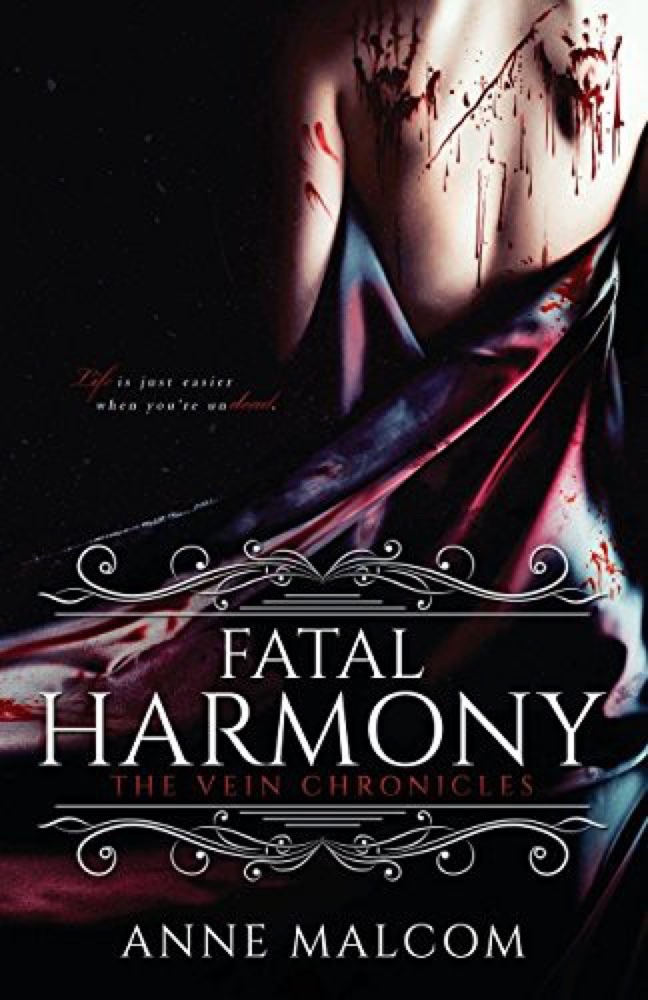
Quotes from Fatal Harmony

Anne Malcom ·  366 pages

Rating: (1.3K votes)


“There is no fuckin’ conclusion to us,” he growled, his gaze tattooing my soul. “No end. Even death doesn’t signify the severing of this. Us. Nothing’s gonna do that, baby. Something as inconsequential as a visit from the grim reaper sure as shit isn’t gonna keep me from you. And we both know from living in this world that death is far from final.”
― Anne Malcom, quote from Fatal Harmony


“EVERY STORY HAS AN ANTAGONIST and a protagonist. Hero and villain. Good and evil. Yada, yada, yada. Thing is, I bet in each story the villain doesn’t consider themselves the epitome of evil. Even the evilest of minds have justification for their acts. They’re the hero of their own story; it just depends on where you stand. I”
― Anne Malcom, quote from Fatal Harmony


“Ripping a piece of glass from my chest, I yelled, “Whoever set off that motherfucking bomb is either buying me a new dress and shoes or is going to die a very grisly death.”
― Anne Malcom, quote from Fatal Harmony


“If you do not come, your brothers will deliver the bodies of three dead children to your apartment at dawn. Children who will have died because of your disobedience,” she stated,”
― Anne Malcom, quote from Fatal Harmony


“The most loyal are usually the most wicked. It is not our enemies we should look to to betray us, but our friends. For we do not expect loyalty from our enemies, do we? Betrayal is only birthed from loyalty. Look at Judas. And Brutus. And Brad Pitt.”
― Anne Malcom, quote from Fatal Harmony


About the author

Anne Malcom
Born place: in New Zealand
See more on GoodReads

Popular quotes

“Thus I continued about a year; all which time our neighbours did take me to be a very godly man, a new and religious man, and did marvel much to see such a great and famous alteration in my life and manners; and indeed so it was, though yet I knew not Christ, nor grace, nor faith, nor hope; for, as I have well seen since, had I then died, my state had been most fearful.”
― John Bunyan, quote from Grace Abounding to the Chief of Sinners


“An old librarian once said to me, " whatever we deal with, coming here is always a visual reward.”
― Josh Hanagarne, quote from The World's Strongest Librarian: A Memoir of Tourette's, Faith, Strength, and the Power of Family


“The history of black workers in the United States illustrates the point. As already noted, from the late nineteenth-century on through the middle of the twentieth century, the labor force participation rate of American blacks was slightly higher than that of American whites. In other words, blacks were just as employable at the wages they received as whites were at their very different wages. The minimum wage law changed that. Before federal minimum wage laws were instituted in the 1930s, the black unemployment rate was slightly lower than the white unemployment rate in 1930. But then followed the Davis-Bacon Act of 1931, the National Industrial Recovery Act of 1933 and the Fair Labor Standards Act of 1938—all of which imposed government-mandated minimum wages, either on a particular sector or more broadly. The National Labor Relations Act of 1935, which promoted unionization, also tended to price black workers out of jobs, in addition to union rules that kept blacks from jobs by barring them from union membership. The National Industrial Recovery Act raised wage rates in the Southern textile industry by 70 percent in just five months and its impact nationwide was estimated to have cost blacks half a million jobs. While this Act was later declared unconstitutional by the Supreme Court, the Fair Labor Standards Act of 1938 was upheld by the High Court and became the major force establishing a national minimum wage. As already noted, the inflation of the 1940s largely nullified the effect of the Fair Labor Standards Act, until it was amended in 1950 to raise minimum wages to a level that would have some actual effect on current wages. By 1954, black unemployment rates were double those of whites and have continued to be at that level or higher. Those particularly hard hit by the resulting unemployment have been black teenage males. Even though 1949—the year before a series of minimum wage escalations began—was a recession year, black teenage male unemployment that year was lower than it was to be at any time during the later boom years of the 1960s. The wide gap between the unemployment rates of black and white teenagers dates from the escalation of the minimum wage and the spread of its coverage in the 1950s. The usual explanations of high unemployment among black teenagers—inexperience, less education, lack of skills, racism—cannot explain their rising unemployment, since all these things were worse during the earlier period when black teenage unemployment was much lower. Taking the more normal year of 1948 as a basis for comparison, black male teenage unemployment then was less than half of what it would be at any time during the decade of the 1960s and less than one-third of what it would be in the 1970s. Unemployment among 16 and 17-year-old black males was no higher than among white males of the same age in 1948. It was only after a series of minimum wage escalations began that black male teenage unemployment not only skyrocketed but became more than double the unemployment rates among white male teenagers. In the early twenty-first century, the unemployment rate for black teenagers exceeded 30 percent. After the American economy turned down in the wake of the housing and financial crises, unemployment among black teenagers reached 40 percent.”
― Thomas Sowell, quote from Basic Economics: A Citizen's Guide to the Economy


“Voidness is that which stands right in the middle between this and that. The void is all-inclusive, having no opposite--there is nothing which it excludes or opposes. It is living void, because all forms come out of it and whoever realizes the void is filled with life and power and the love of all beings.”
― Bruce Lee, quote from Tao of Jeet Kune Do


“Necessity could drive you to things that seemed impossible, once upon a time.”
― Abigail Haas, quote from Dangerous Boys


Interesting books

Sleeping Giants
(36.3K)
Sleeping Giants
by Sylvain Neuvel
Broken April
(2.8K)
Broken April
by Ismail Kadare
The Book of Sand and Shakespeare's Memory
(4.9K)
The Book of Sand and...
by Jorge Luis Borges
Ex Libris: Confessions of a Common Reader
(9K)
Ex Libris: Confessio...
by Anne Fadiman
Secrets of the Clans
(7.6K)
Secrets of the Clans
by Erin Hunter
A Morbid Taste for Bones
(26.6K)
A Morbid Taste for B...
by Ellis Peters

About BookQuoters

BookQuoters is a community of passionate readers who enjoy sharing the most meaningful, memorable and interesting quotes from great books. As the world communicates more and more via texts, memes and sound bytes, short but profound quotes from books have become more relevant and important. For some of us a quote becomes a mantra, a goal or a philosophy by which we live. For all of us, quotes are a great way to remember a book and to carry with us the author’s best ideas.

We thoughtfully gather quotes from our favorite books, both classic and current, and choose the ones that are most thought-provoking. Each quote represents a book that is interesting, well written and has potential to enhance the reader’s life. We also accept submissions from our visitors and will select the quotes we feel are most appealing to the BookQuoters community.

Founded in 2023, BookQuoters has quickly become a large and vibrant community of people who share an affinity for books. Books are seen by some as a throwback to a previous world; conversely, gleaning the main ideas of a book via a quote or a quick summary is typical of the Information Age but is a habit disdained by some diehard readers. We feel that we have the best of both worlds at BookQuoters; we read books cover-to-cover but offer you some of the highlights. We hope you’ll join us.